
Voice Controlled Kitchen Manhattan: Alexa, Siri & Google Design Guide
Imagine preparing a gourmet meal without ever touching a light switch, timer, or smartphone screen. Welcome to the era of the voice controlled kitchen Manhattan homeowners are rapidly embracing. As smart home technology evolves from novelty to necessity, the kitchen has become ground zero for voice-first innovation. Whether you're a busy professional managing morning chaos, a culinary enthusiast following complex recipes, or someone who values hygiene in food preparation spaces, voice-activated kitchen technology is transforming how we interact with the heart of our homes.
In Manhattan's competitive real estate landscape, a thoughtfully designed smart kitchen Manhattan installation isn't just a luxury - it's an investment that enhances daily efficiency, increases property value, and provides a glimpse into tomorrow's living standards. This comprehensive guide explores how to design and optimize a voice controlled kitchen Manhattan residents will love, covering everything from essential Alexa kitchen commands, Google Home kitchen integration, and Siri kitchen control to network infrastructure, user experience design, and privacy considerations.
Ready to transform your cooking space into a hands-free kitchen Manhattan culinary command center? Let's explore how voice technology can revolutionize your Manhattan kitchen.
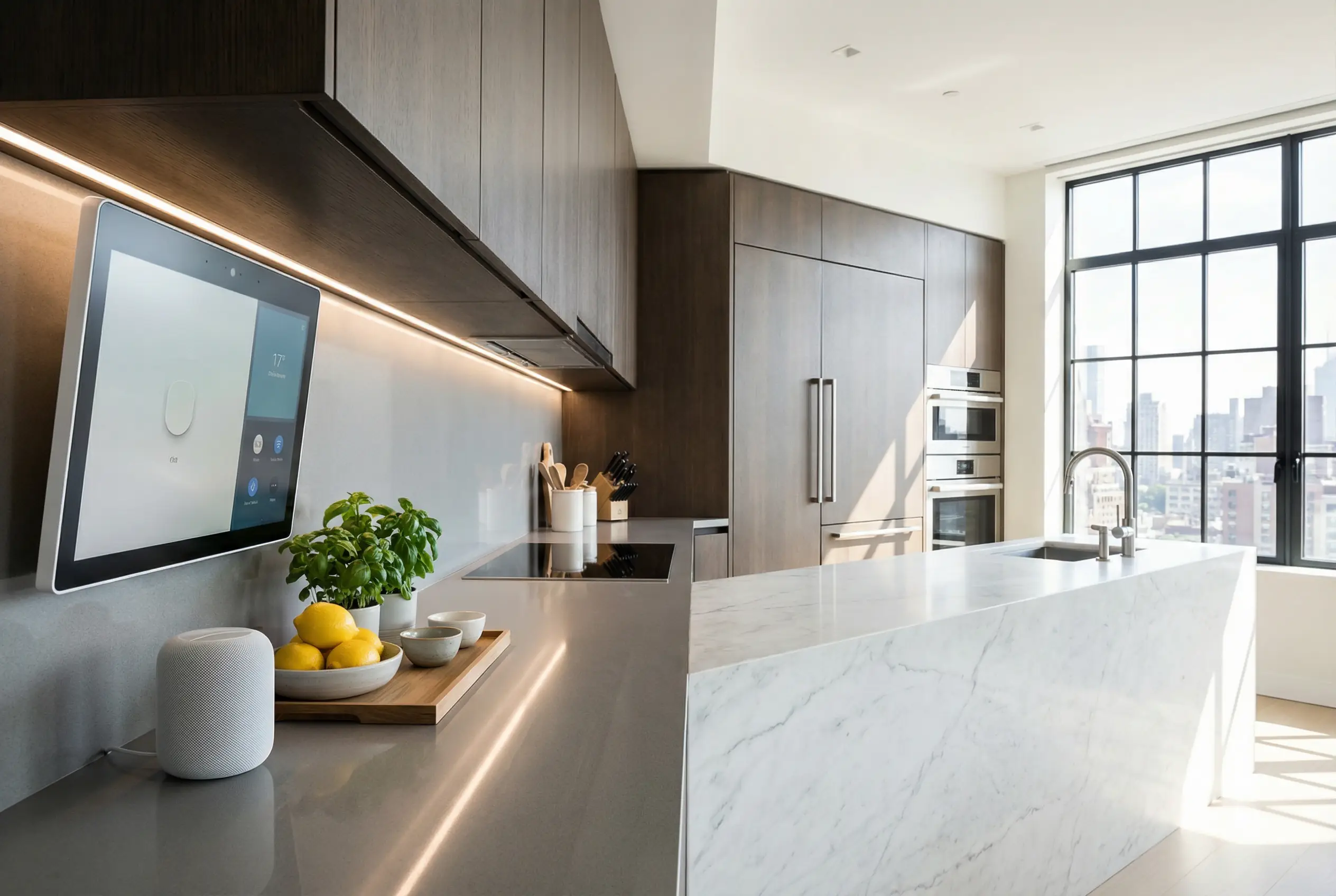
The Hygiene and Efficiency Revolution: Why Voice Control Matters
Hands-Free Hygiene in Food Preparation Zones
In a post-pandemic world, minimizing touch points in the kitchen has shifted from preference to priority. A voice controlled kitchen Manhattan design eliminates the need to touch light switches, appliance controls, or smart devices with flour-dusted or raw-meat-contaminated hands. This isn't just about convenience - it's about creating a fundamentally cleaner, safer touchless kitchen environment.
Voice commands allow you to adjust lighting, set timers, start appliances, and even check recipes without ever compromising food safety protocols. Professional chefs have long understood the importance of maintaining clean hands during food preparation, and now residential kitchens can adopt the same standards. The ability to control your environment vocally means fewer surface contaminations, reduced cross-contamination risks, and a kitchen that meets higher hygiene standards naturally.
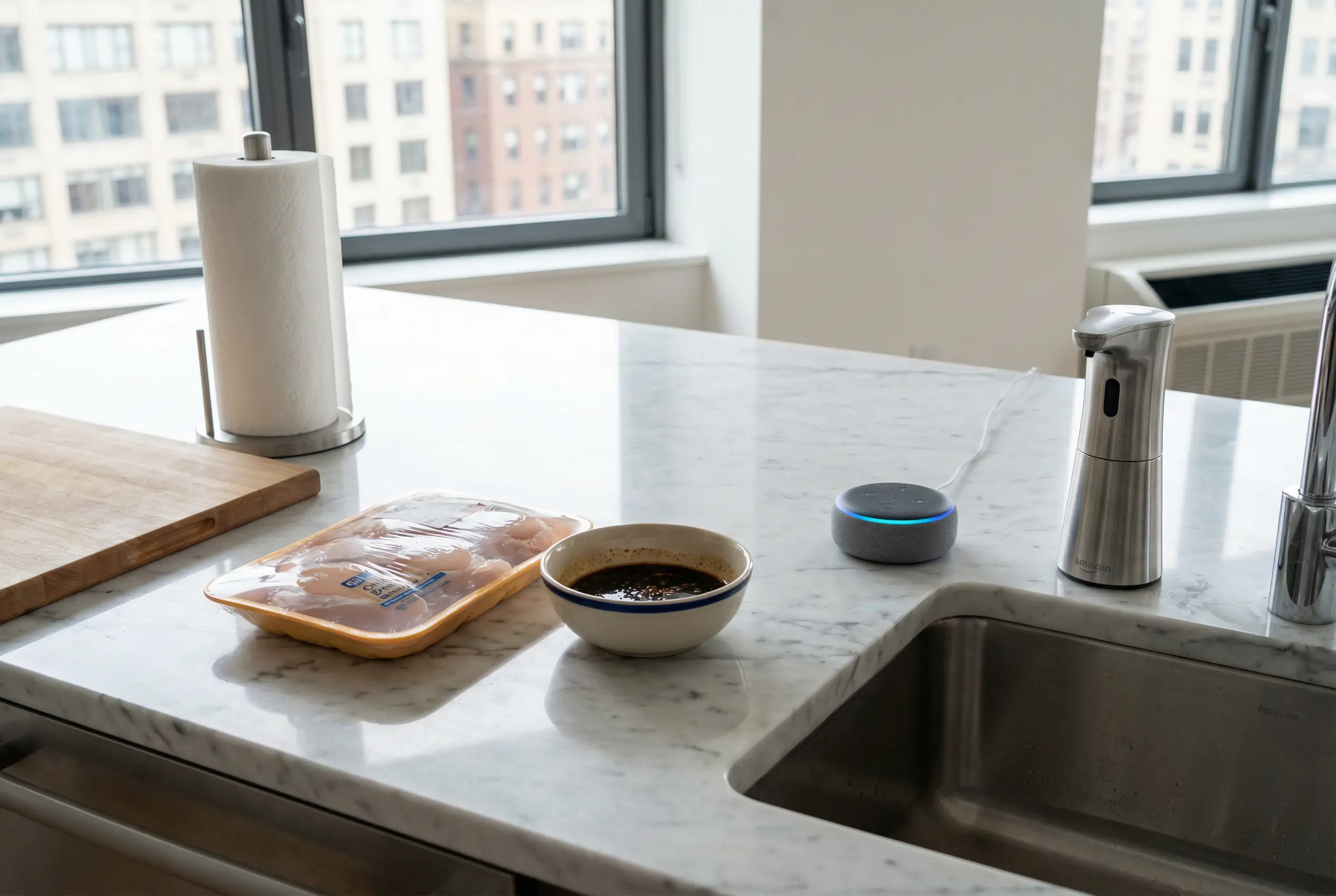
Consider the typical cooking workflow: you're kneading dough, marinating chicken, or handling fresh seafood. Traditionally, you'd need to wash your hands, adjust the oven, then wash again. With voice control, you simply speak your command and continue working seamlessly. This efficiency gain multiplies across dozens of daily interactions, saving water, time, and maintaining uninterrupted workflow.
Workflow Efficiency That Transforms Daily Cooking
Beyond hygiene, voice technology for kitchens dramatically streamlines kitchen workflows. Research shows that voice commands can be executed three to four times faster than manual controls, particularly when your hands are occupied. In Manhattan's fast-paced lifestyle, where every minute counts during morning routines or dinner preparation, this efficiency compounds into significant time savings.
A properly configured voice controlled kitchen Manhattan apartment or townhouse enables true multitasking. Preheat your oven while chopping vegetables, adjust recipe quantities while your hands are covered in dough, or add items to your shopping list as you notice you're running low - all without breaking stride. The cognitive load reduction is equally valuable; you don't need to remember to set timers or adjust temperatures because voice reminders and commands become natural extensions of your cooking process.
Smart kitchen assistants also learn your preferences over time, offering personalized recipe suggestions based on dietary restrictions, suggesting wine pairings for your meal, or even walking you through complex cooking techniques step-by-step. This transforms your kitchen from a static workspace into an adaptive culinary partner that evolves with your skills and preferences.
Real-Time Information Access While Cooking
Perhaps the most underestimated benefit of voice control is instant access to information without interrupting your workflow. Need a substitution for an ingredient you just discovered you're missing? Ask. Wondering about the internal temperature for medium-rare lamb? Voice assistants provide immediate, accurate answers. Want to know the nutritional content of your dish or convert tablespoons to milliliters? The information arrives instantly, keeping you in your cooking flow state.
This seamless information access is particularly valuable for home cooks expanding their culinary repertoire. Voice technology effectively provides an always-available sous chef who never gets tired, never judges your questions, and has access to virtually unlimited culinary knowledge. For Manhattan residents who love to entertain but may not have formal culinary training, this democratizes gourmet cooking and builds confidence in the kitchen.
Ready to experience the hygiene and efficiency benefits firsthand? KS Renovation Group specializes in designing and installing voice controlled kitchen Manhattan solutions that seamlessly integrate with your lifestyle. Contact us today for a smart kitchen demonstration Manhattan.
Must-Have Voice Commands and Smart Kitchen Integrations
Essential Voice Commands for Daily Cooking
The foundation of any successful voice controlled kitchen Manhattan installation is a well-planned command structure that covers your most frequent kitchen tasks. While voice assistants understand natural language, establishing consistent command patterns creates more reliable interactions and faster response times.
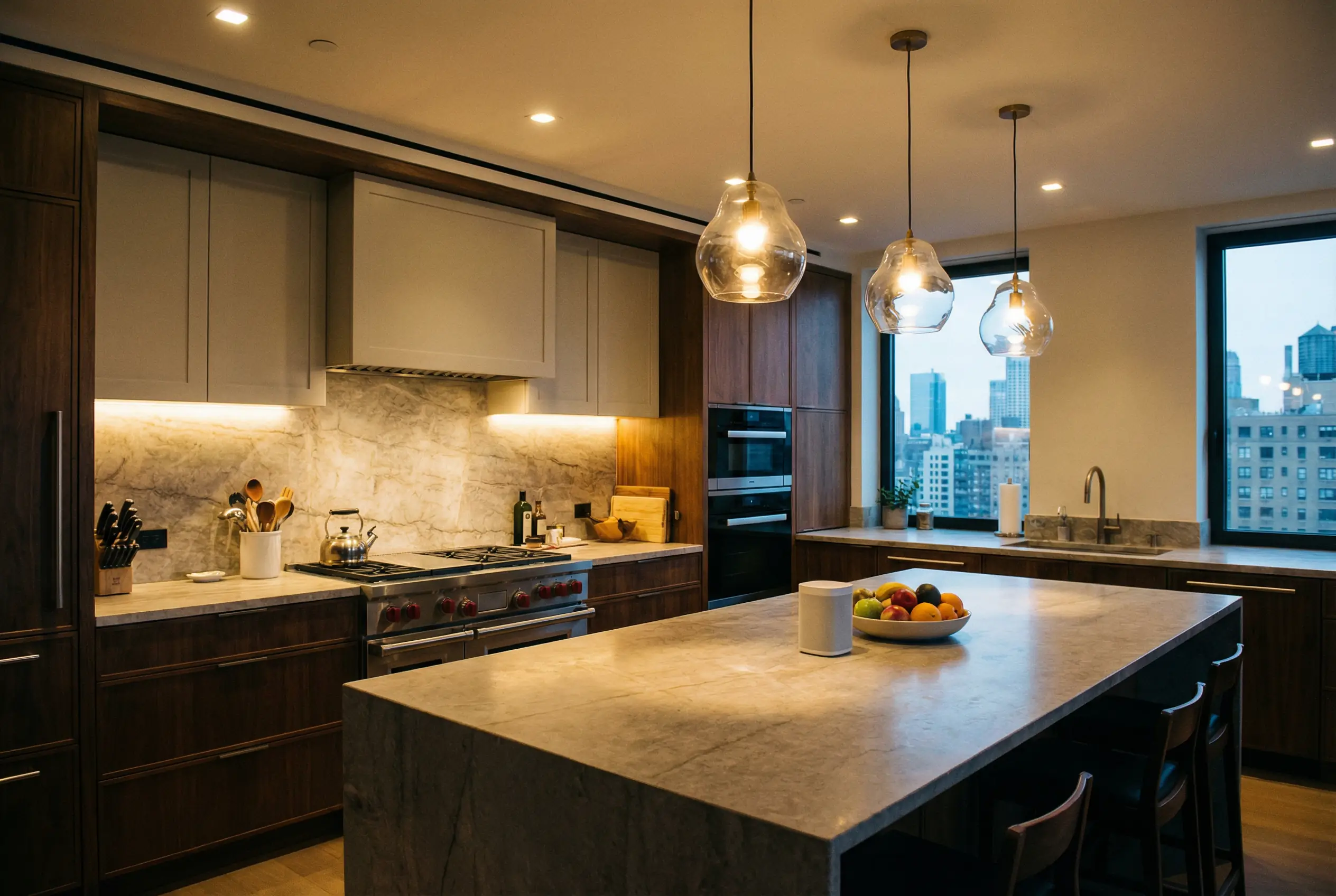
Lighting and Ambiance Control: "Alexa, set kitchen lights to 75%," "Hey Google, dim the pendant lights," or "Siri, turn on task lighting" give you instant environmental control. Advanced setups can include scene commands like "Alexa, cooking mode" that simultaneously adjusts multiple lights to optimal task-lighting levels while playing your preferred cooking playlist at appropriate volume.
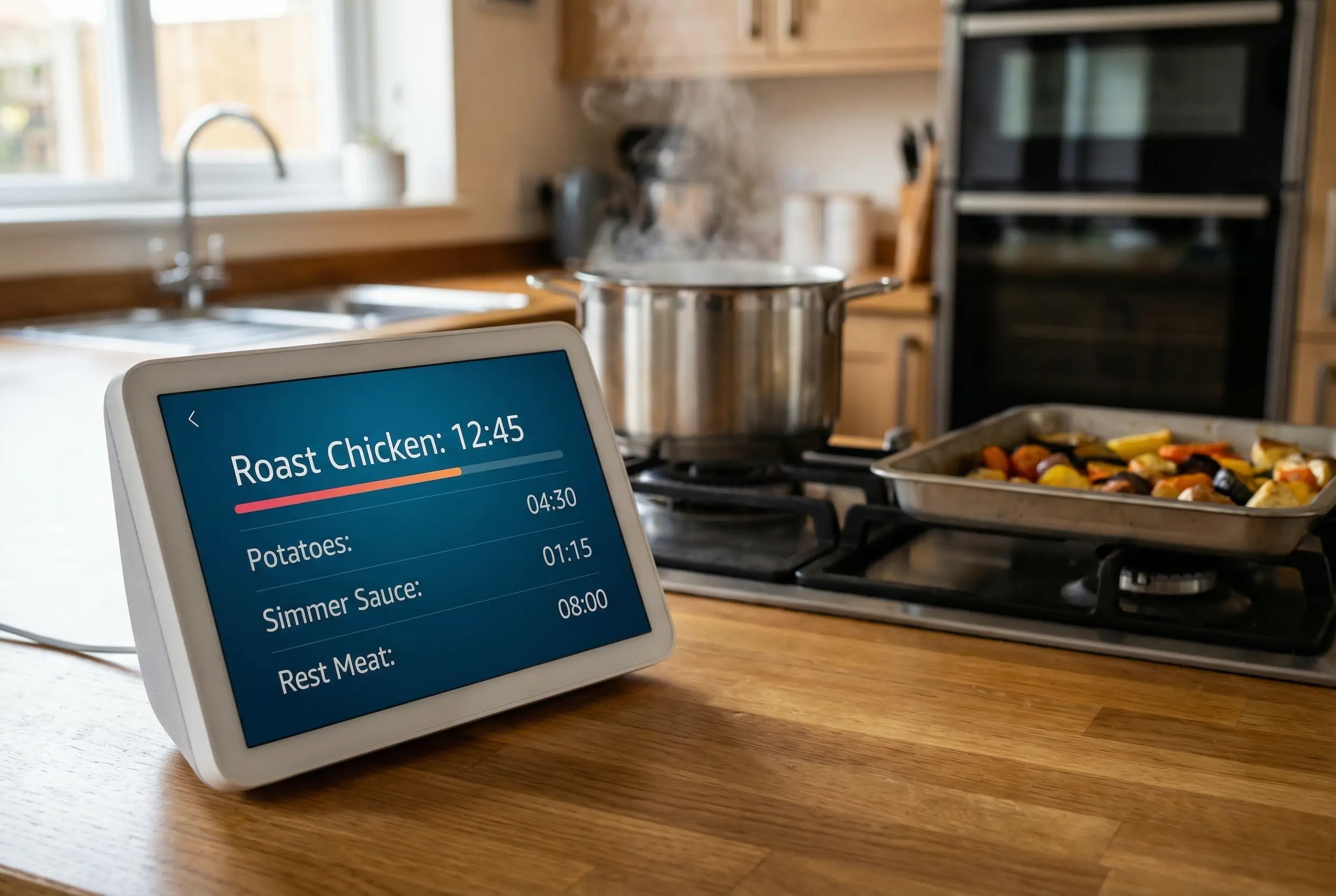
Timer and Reminder Management: Multiple simultaneous timers are essential for complex meals. Commands like "Set a pasta timer for 11 minutes," "Set a bread timer for 45 minutes," and "Remind me to flip the steak in 4 minutes" allow you to manage multiple cooking processes without mental strain. Voice assistants for cooking can announce which timer is expiring, preventing the confusion that often accompanies multiple device alarms.
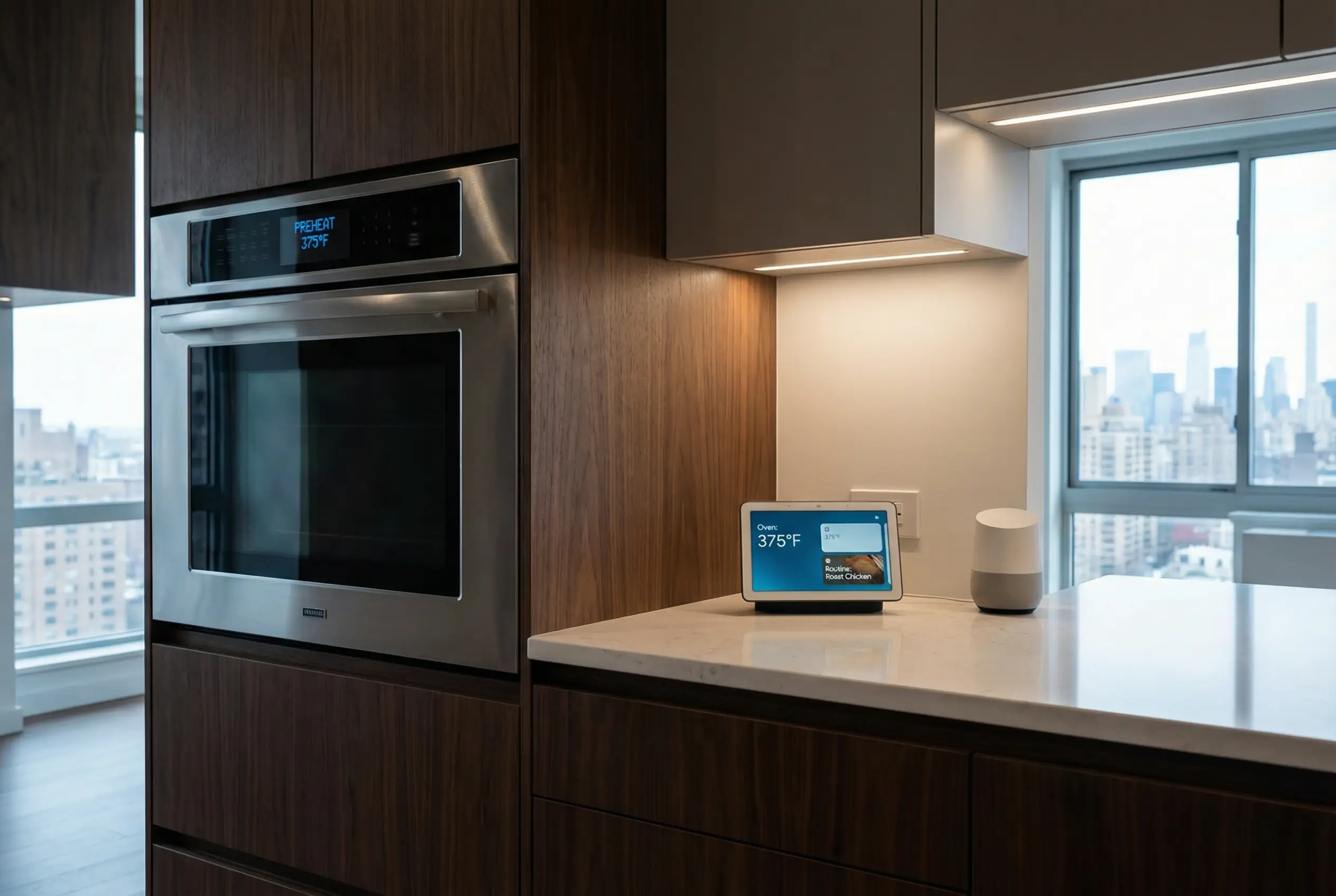
Appliance Control: Modern smart kitchen appliances integrate directly with voice platforms. "Preheat the oven to 425 degrees," "Start the dishwasher," "Run the garbage disposal," or "Set the refrigerator to vacation mode" transform appliance interaction from manual button-pressing to effortless voice commands. For a voice controlled kitchen Manhattan renovation, ensure your appliance selections prioritize voice compatibility from manufacturers like GE, Whirlpool, LG, and Samsung.
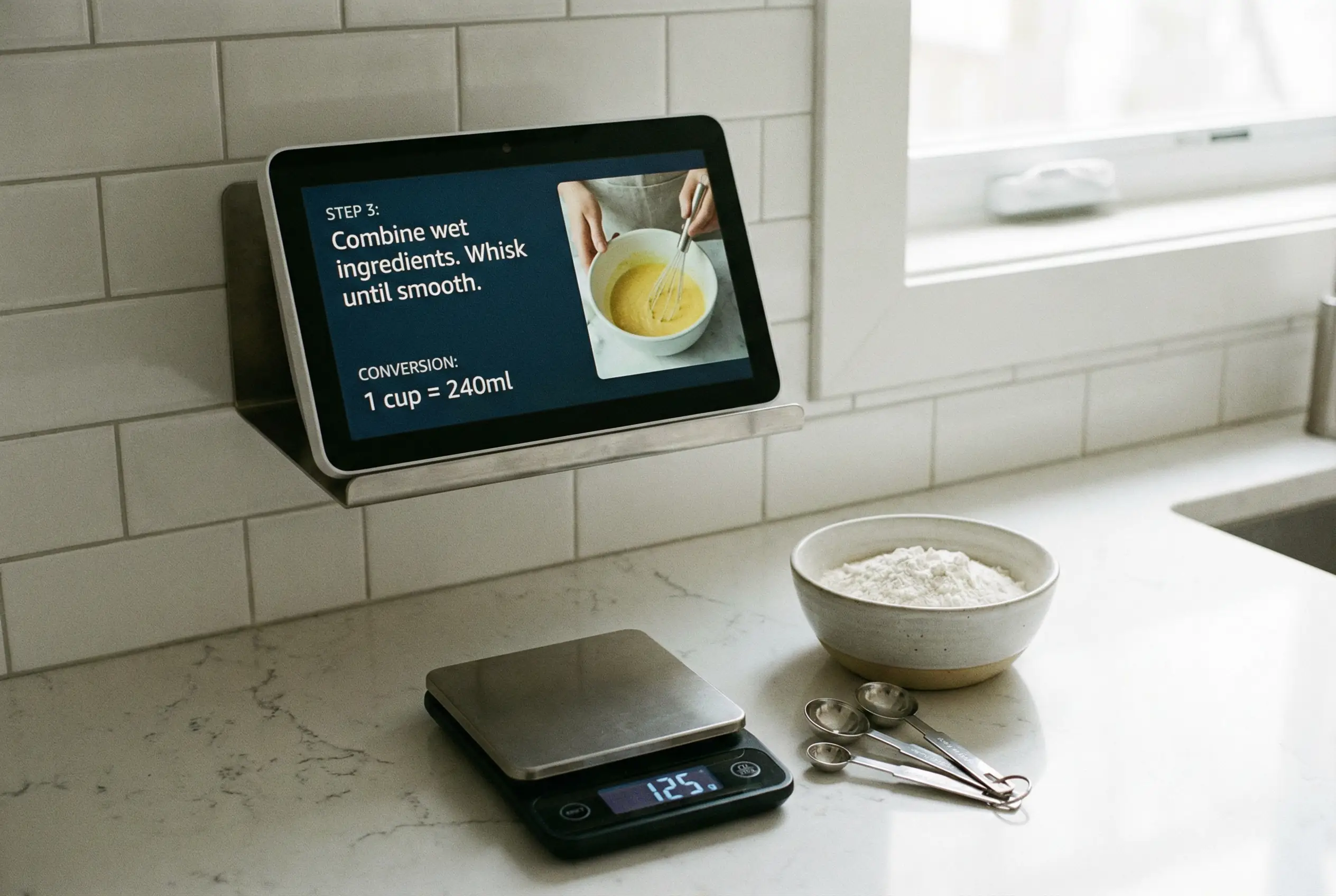
Recipe and Measurement Assistance: "How many teaspoons in a tablespoon?", "What's the next step?", "Repeat the last instruction," or "Convert 250 grams to cups" keep you moving through recipes without stopping to search online or fumble with conversion charts. Many voice-enabled kitchen devices now offer step-by-step recipe guidance, reading instructions aloud and pausing for your confirmation before proceeding.
Smart Appliances That Respond to Your Voice
The appliance ecosystem for voice controlled kitchens has matured significantly. Today's smart kitchen appliances offer genuine functional benefits beyond the novelty factor, making them worthwhile investments for Manhattan kitchen renovations.
Smart Ovens and Ranges: Brands like Café, Bosch, and Wolf offer ovens with full voice integration. Beyond basic preheating, you can adjust temperatures mid-cook, activate specific cooking modes (convection, broil, bake), and receive notifications when preheating is complete or when cooking time has elapsed. Some models even offer guided cooking programs that adjust temperatures automatically based on the dish you're preparing.
Connected Refrigerators: High-end refrigerators from Samsung and LG feature internal cameras, inventory tracking, and voice control. Ask your refrigerator what's inside, add items to your shopping list, or check expiration dates without opening the door. Some models integrate with recipe services, suggesting meals based on current inventory - particularly valuable for reducing food waste in Manhattan's sustainability-conscious culture.
Voice-Enabled Faucets: Touchless faucets from Moen and Delta allow precise water dispensing through voice commands: "Dispense two cups of water," or "Turn on filtered water." This hands-free operation is invaluable when following recipes requiring specific water measurements or when your hands are covered in food.
Smart Coffee Makers and Small Appliances: From voice-controlled coffee makers that start brewing as you wake up to smart slow cookers you can adjust from anywhere, small appliances increasingly support voice integration. Brands like Hamilton Beach, Instant Pot, and Anova precision cookers offer sophisticated voice control for automated cooking processes.

Integration Ecosystems: Choosing Your Platform
Manhattan residents designing a voice controlled kitchen face an important decision: which ecosystem to build around? Each major platform - Amazon Alexa, Google Assistant, and Apple HomeKit (Siri) - offers distinct advantages.
Amazon Alexa for kitchens: Boasts the widest smart home device compatibility and most mature third-party integrations. Alexa excels in routines (complex multi-device automations), has extensive recipe and cooking skill libraries, and offers the most affordable entry points through Echo devices. For a comprehensive voice controlled kitchen Manhattan installation, Alexa typically provides the broadest appliance compatibility.
Google Assistant kitchen control: Offers superior natural language processing and contextual understanding, making conversations feel more natural. Google's integration with Search provides better general information queries and recipe lookups. The Nest Hub displays work beautifully as kitchen smart displays, combining voice control with visual recipe displays and video calling capabilities.
Apple HomeKit kitchen: Prioritizes privacy and security, with all automation processing handled locally on your devices when possible. HomeKit integrations tend to be more selective but higher quality, and the ecosystem works seamlessly if you're already invested in Apple products. Siri kitchen control's improved responsiveness and the ability to control your kitchen from any Apple device (iPhone, iPad, Apple Watch, HomePod) creates a consistent experience.
Many sophisticated smart kitchens use a hybrid approach, selecting devices based on best-in-class features rather than limiting themselves to a single ecosystem. Bridge devices and platforms like Home Assistant can unify disparate systems, though this requires more technical setup.
Transform your cooking space with seamlessly integrated voice technology. KS Renovation Group has extensive experience designing voice controlled kitchen Manhattan installations across all major platforms. Schedule your consultation to explore which ecosystem fits your needs.
Network Layout and Technical Infrastructure
Wi-Fi Coverage and Network Architecture
The performance of your voice controlled kitchen Manhattan installation depends entirely on robust, reliable smart home network infrastructure. Nothing frustrates users faster than voice commands that go unheard or appliances that disconnect sporadically. Professional-grade network design isn't optional - it's foundational.
Mesh Wi-Fi Systems: For Manhattan apartments and townhouses with challenging layouts (thick walls, multiple floors, or interference from neighboring networks), mesh Wi-Fi systems like Eero, Google Nest Wifi, or Ubiquiti provide seamless coverage. Unlike traditional routers with range extenders, mesh systems create a unified network that devices transition between automatically, preventing the disconnections that plague smart home setups.
Dedicated IoT Networks: Security-conscious homeowners should consider segregating smart home devices onto a separate network from personal computers and smartphones. This network segmentation limits potential security vulnerabilities - if a smart toaster is compromised, attackers can't access your laptop. Most modern routers support guest networks that can be repurposed as dedicated IoT networks, maintaining functionality while improving security posture.
Bandwidth and Speed Requirements: While individual smart devices consume minimal bandwidth, voice-controlled systems work best with reliable, fast internet connections. Manhattan residents should aim for minimum speeds of 100 Mbps for households with extensive smart home integration. More importantly, upload speeds matter for voice recognition - commands must be transmitted to cloud servers for processing, making symmetrical or high-upload connections valuable.
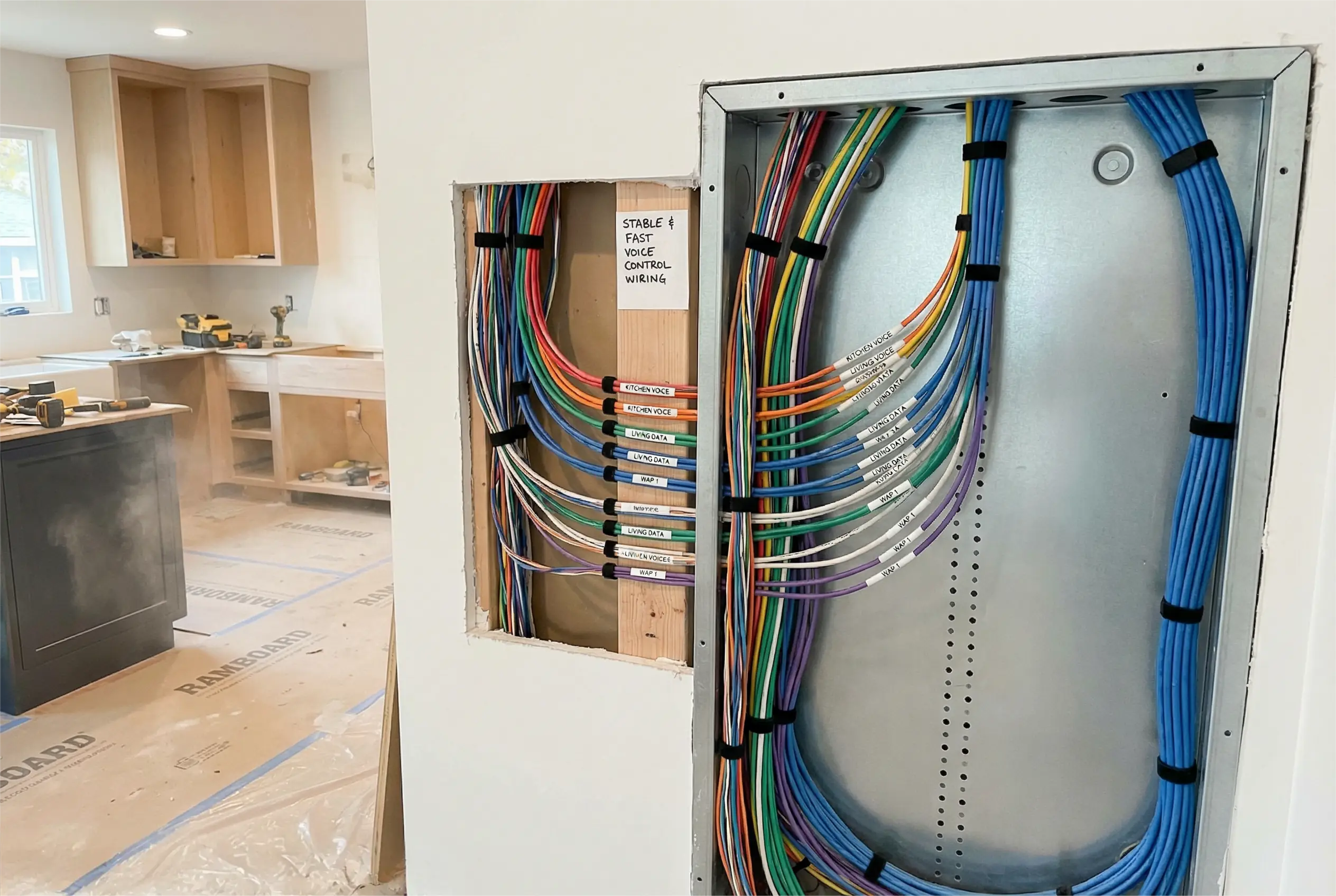
Ethernet Backhaul for Critical Devices: Where possible, hardwire stationary devices like smart displays, smart refrigerators, and voice assistant hubs via Ethernet. This reduces Wi-Fi congestion, improves reliability, and provides faster response times. During renovations, running Ethernet cables to strategic kitchen locations future-proofs your voice controlled kitchen investment.
Smart Device Placement for Optimal Voice Recognition
Voice recognition accuracy depends heavily on microphone placement relative to kitchen noise sources and typical user positions. Thoughtful spatial planning dramatically improves the user experience.
Strategic Voice Assistant Positioning: Place primary voice assistants 4-6 feet from main cooking work areas at roughly ear height when standing. Avoid positioning directly adjacent to noise sources like range hoods, dishwashers, or refrigerators, as mechanical noise interferes with wake-word detection. For larger kitchens, multiple devices create better coverage - one near the main cooking zone, another near the sink area, and potentially a smart display near seating or planning areas.
Microphone Array Considerations: Modern voice assistants use far-field microphone arrays designed to pick up voices from across rooms while filtering background noise. Devices with more microphones (typically 4-8) offer superior performance in noisy kitchen environments. Position these devices with clear line-of-sight to cooking areas when possible, as physical obstructions can interfere with voice detection.
Smart Displays as Kitchen Command Centers: Devices like Amazon Echo Show, Google Nest Hub Max, or tablets running dedicated smart home apps serve as visual-plus-voice control centers. Position these where you can glance at them while cooking - seeing recipe steps, timer countdowns, or camera feeds enhances the voice-only experience. Mounting solutions keep displays at optimal viewing angles while protecting them from cooking splatter.
Backup Control Options: Despite focusing on voice, always maintain alternative control methods. Physical switches, app controls, and automation routines ensure functionality even when voice isn't convenient (during phone calls, in early morning quiet, or when dealing with temporary network issues). This redundancy characterizes professionally designed voice controlled kitchen Manhattan installations.
Power and Connectivity Requirements
Smart kitchen devices require both reliable power and stable connectivity, presenting installation challenges in older Manhattan buildings not originally designed for extensive electronic integration.
Electrical Circuit Planning: A voice controlled kitchen Manhattan renovation often necessitates additional electrical circuits to support increased device loads. Smart appliances, multiple voice assistants, smart displays, and charging stations for mobile devices collectively draw significant power. Work with licensed electricians to ensure adequate circuit capacity, properly positioned outlets (including USB charging stations), and GFCI protection where required by code.
Outlet Placement Strategy: Modern kitchens benefit from abundant, well-positioned outlets. Beyond standard countertop outlets, consider pop-up outlets integrated into countertops or islands, dedicated outlets for smart displays mounted on backsplashes, and weatherproof outdoor-rated outlets if your kitchen extends to terraces or balconies. Outlets positioned every 2-3 feet along countertop runs eliminate extension cord dependence.
Low-Voltage Wiring: Some integration systems (particularly for motorized shades, advanced lighting control, or custom automation) use low-voltage wiring. Plan these runs during renovation phases when walls are open. CAT6 Ethernet cables, speaker wires for distributed audio, and control wiring for motorized systems should all be considered during the design phase.
Backup Power Considerations: While whole-home battery backup systems remain expensive, critical smart home infrastructure (router, primary voice assistant hub, smart display) can be connected to small UPS (uninterruptible power supply) units. This ensures your voice controlled kitchen remains functional during brief power outages common in urban environments.
KS Renovation Group manages all aspects of smart kitchen infrastructure - from network design and electrical upgrades to device integration and testing. Our experienced team ensures your voice controlled kitchen Manhattan project delivers reliable, professional-grade performance.
User Experience Design and Privacy Considerations
Designing Intuitive Voice Interactions
The most technologically sophisticated voice controlled kitchen Manhattan installation fails if users find interactions frustrating or unintuitive. User experience design principles separate functional smart kitchens from truly exceptional ones.
Command Simplicity and Consistency: Establish command patterns that feel natural and remain consistent across functions. Rather than requiring users to memorize complex syntax, design around conversational phrases: "Start coffee" instead of "Alexa, tell Coffee Maker skill to begin brewing cycle." The best implementations feel like speaking to a helpful assistant rather than issuing computer commands.
Multi-User Household Considerations: Different family members have varying comfort levels with technology and different usage patterns. Design your voice controlled system with multiple skill levels in mind - simple commands for quick tasks, advanced routines for power users. Voice recognition profiles help systems provide personalized responses (calendar access, music preferences, shopping lists) while maintaining household-wide control over shared functions like lighting and appliances.
Feedback and Confirmation: Users need clear feedback that commands were heard and understood. Visual indicators (light rings on Echo devices, screen confirmations on smart displays) combined with brief audio confirmations create confidence. For critical commands (oven temperature changes, appliance activation), explicit confirmations prevent accidents: "Setting oven to 425 degrees" rather than a simple acknowledgment beep.
Error Recovery and Fallbacks: When voice recognition fails or commands aren't understood, the system should guide users toward success rather than simply saying "I don't understand." Helpful error messages like "I can control the oven, lights, or timers. What would you like to adjust?" teach users available functions while maintaining engagement.
Privacy and Security in Voice-Enabled Spaces
Privacy concerns represent the primary hesitation among consumers considering voice controlled kitchen technology. Addressing these concerns through thoughtful design and informed choices is essential for Manhattan residents particularly conscious of privacy in dense urban environments.
Understanding Data Collection: Voice assistants function by continuously listening for wake words, then transmitting subsequent audio to cloud servers for processing. This fundamental architecture raises valid smart home privacy questions. However, understanding what data is collected, how it's used, and what controls exist helps users make informed decisions rather than reacting to vague concerns.
Microphone Mute Controls: All major voice assistants include physical microphone mute buttons that electronically disconnect microphones. Users uncomfortable with always-listening devices can mute microphones when not actively using voice control, manually unmuting when needed. While this reduces convenience, it provides absolute assurance that no audio is being captured during private conversations.
Voice Recording Management: Amazon, Google, and Apple all provide controls to review and delete voice recordings. Users can access complete histories of their voice interactions, listen to what was captured, and delete individual recordings or set automatic deletion schedules (3 months, 18 months, or rolling deletion). Regular review of these recordings helps users understand exactly what their devices hear and store.
Privacy-First Platform Choices: Apple HomeKit processes many commands on-device rather than transmitting to cloud servers, offering enhanced privacy for users willing to accept somewhat limited functionality compared to cloud-based alternatives. Privacy-focused alternatives like Mycroft and Home Assistant allow completely local voice processing for users with technical expertise to set up these more complex systems.
Accessibility Benefits of Voice Technology
Voice controlled kitchen Manhattan installations offer profound benefits for users with mobility limitations, visual impairments, or other accessibility needs - transforming kitchens from challenging spaces into empowering environments.
Mobility and Dexterity Support: For individuals with arthritis, limited mobility, or wheelchair users, voice control eliminates the physical challenges of reaching switches, manipulating small appliance controls, or operating faucets. The ability to control the entire kitchen environment vocally creates independence and reduces reliance on assistance from others.
Visual Impairment Accommodation: Voice assistants provide audio feedback that makes kitchen navigation intuitive for blind or low-vision users. Spoken recipe instructions, timer announcements, and verbal confirmations of appliance states create a comprehensive audio interface. Smart displays with accessibility features offer high-contrast visual options and voice descriptions of on-screen content.
Cognitive Load Reduction: For elderly users or those with cognitive challenges, complex device interfaces can be overwhelming. Simple voice commands reduce cognitive burden - "Turn on the lights" requires less mental processing than navigating multi-button light switches or dimmer controls. This simplification extends independence and allows continued kitchen use as cognitive abilities change.
Aging-in-Place Design: As Manhattan residents plan for long-term residence, voice controlled kitchens support aging-in-place goals by anticipating future accessibility needs. The kitchen that serves a young family well today remains functional and accessible as family members age, eliminating the need for expensive retrofits or difficult relocations later.
Building Voice Habits and User Adoption
Even the most carefully designed voice controlled kitchen Manhattan installation requires intentional habit formation for successful adoption. Technology implementation is only half the equation - user training and gradual adoption drive long-term satisfaction.
Start with High-Value Commands: Begin with the three to five voice commands that provide the most immediate value - typically lighting control, timers, and music playback. Master these basics before expanding to more complex functions. Success with simple commands builds confidence and creates positive associations with voice technology.
Progressive Feature Introduction: Resist the temptation to activate every possible feature immediately. Instead, add new capabilities gradually as existing ones become habitual. This staged approach prevents overwhelm and allows proper learning of each function. Monthly additions of new skills or routines keep the system fresh without becoming burdensome.
Guest and Visitor Experiences: Design your voice system to be welcoming but not overwhelming for guests. A discrete instruction card near the main voice assistant with five to seven common commands helps visitors feel comfortable using voice features without extensive explanation. Consider guest-specific playlists, lighting scenes, or routines that visitors can access without exposing personal information or settings.
Regular Optimization and Updates: Voice platforms continuously evolve with new features, improved recognition, and expanded integrations. Schedule quarterly reviews of your voice controlled kitchen setup to discover new capabilities, remove unused features, and optimize routines based on usage patterns. This maintenance ensures your system remains current and valuable rather than becoming neglected novelty technology.
Experience the perfect blend of technology and usability. KS Renovation Group provides comprehensive training and optimization services, ensuring your family fully adopts and benefits from your new voice controlled kitchen Manhattan installation.
Conclusion: Your Voice-Activated Kitchen Awaits
The transformation from traditional to voice controlled kitchen Manhattan spaces represents more than technological novelty - it's a fundamental reimagining of how we interact with the heart of our homes. As we've explored, voice-first kitchen design delivers measurable benefits: enhanced hygiene through touch-free control, dramatic efficiency improvements through hands-free multitasking, seamless access to culinary information, and accessibility advantages that extend kitchen independence to users with varying abilities.
Success requires more than purchasing smart devices. Professional design considers network infrastructure that ensures reliable connectivity, strategic device placement that optimizes voice recognition in challenging acoustic environments, thoughtful integration of appliances and systems that work harmoniously together, and user experience design that makes voice control intuitive rather than frustrating. Privacy considerations and security measures protect your family while enabling the convenience of connected technology.
Manhattan's unique challenges - from complex apartment layouts and challenging Wi-Fi environments to the desire for cutting-edge technology that increases property value - demand expertise beyond typical smart home installations. Whether you're renovating a compact Manhattan apartment or designing a sprawling townhouse kitchen, voice-first technology should enhance rather than complicate your daily routines.
The voice controlled kitchen revolution is happening now. The question isn't whether voice technology will become standard in premium kitchens - it already is. The question is whether your kitchen will lead this transformation or follow behind. With strategic planning, professional installation, and thoughtful user experience design, your kitchen can become an intelligent partner in daily life rather than just a room where cooking happens.
Your voice-activated culinary command center awaits. The investment in a properly designed voice controlled kitchen Manhattan installation pays dividends daily through time saved, stress reduced, and capabilities expanded. Don't settle for half-measures or pieced-together solutions that deliver frustration instead of function.
Ready to transform your kitchen into a voice-first culinary command center? KS Renovation Group specializes in comprehensive voice controlled kitchen Manhattan installations - from initial consultation and network design through appliance integration and user training. Contact us today to schedule your personalized smart kitchen demonstration and discover how voice technology can revolutionize your cooking experience.
Frequently Asked Questions
Q: What factors should I consider when planning a voice controlled kitchen Manhattan installation?
A: Several key factors influence your voice controlled kitchen design. First, evaluate your existing infrastructure including current appliances, Wi-Fi coverage, and electrical capacity. Second, consider your household's technology comfort level and which voice platform aligns with devices you already use. Third, prioritize which functions matter most to your daily routines - lighting, appliances, timers, or comprehensive automation. Fourth, assess your kitchen layout and acoustics to determine optimal device placement. Finally, think about future needs and scalability as voice technology continues evolving. KS Renovation Group provides comprehensive consultations to evaluate these factors and create a customized plan based on your specific requirements and existing conditions.
Q: Will voice control work if my internet connection is down?
A: Most voice control functionality requires internet connectivity since processing happens on cloud servers. However, some capabilities remain functional offline: Apple HomeKit processes many commands locally on your home hub (Apple TV or HomePod), allowing continued operation of HomeKit-enabled devices without internet. Some smart switches and local automation routines continue functioning based on last-known settings. Advanced systems using local control platforms like Home Assistant can maintain nearly full functionality offline. For mission-critical functions like lighting, always maintain physical switch backups. A properly designed voice controlled kitchen Manhattan installation includes these redundancies.
Q: Which voice assistant platform is best for kitchens?
A: The "best" platform depends on your priorities. Amazon Alexa offers the widest device compatibility and most mature cooking-specific features, making it excellent for comprehensive smart kitchens. Google Assistant provides superior natural language understanding and better general information queries, ideal for recipe research and cooking questions. Apple HomeKit prioritizes privacy and works seamlessly with Apple devices, perfect for privacy-conscious users already in the Apple ecosystem. Many sophisticated installations use multiple platforms, selecting best-in-class devices regardless of ecosystem. KS Renovation Group helps evaluate your specific needs to recommend the optimal platform configuration.
Q: Are voice controlled kitchens secure and private?
A: When properly configured, voice controlled kitchens can be both functional and privacy-respecting. Key security measures include: using strong, unique passwords for all accounts and Wi-Fi networks, enabling two-factor authentication on voice assistant accounts, regularly reviewing and deleting voice recordings through platform privacy controls, utilizing physical microphone mute buttons during private conversations, and segregating smart home devices onto separate network segments from personal computers. All major platforms (Amazon, Google, Apple) have significantly enhanced privacy controls in recent years, allowing users to limit data retention and control what information is collected. The privacy risks, while real, are manageable through informed configuration choices.
Q: Can I retrofit voice control into my existing Manhattan kitchen?
A: Absolutely. Voice control retrofits are often simpler than comprehensive renovations. Start by assessing your existing appliances - many newer models (less than 5 years old) may already support smart connectivity that just needs activation. Smart plugs add voice control to traditional small appliances like coffee makers and slow cookers. Smart switches replace existing light switches, adding voice control without rewiring. Network assessment identifies if your existing Wi-Fi adequately covers the kitchen or if mesh upgrade is needed. Voice assistant devices integrate seamlessly into existing décor. KS Renovation Group specializes in both retrofit installations and comprehensive Manhattan kitchen renovations, tailoring solutions to your space, budget, and goals. Schedule a consultation to explore what's possible in your existing Manhattan kitchen.

You may also be interested




KS Renovation Blog
Get Inspired
Meaningful information about home remodeling for the true NYC homeowners.

OUr Clients Say

William Plotch
amy schorr
gberaka
NYC kitchen remodeling Projects and more


