You’ve been living in your pre-war Manhattan apartment for years, and you know exactly what it could be. Take down that wall between the kitchen and the dining room, and suddenly you have the open, light-filled space that every renovation magazine promises. It’s a compelling vision – and in Manhattan co-ops and condos, it’s entirely achievable. But opening a load-bearing wall in a pre-war building is not a weekend project. It is a structural, legal, and engineering undertaking that requires the right professionals, the right documents, and the right sequence of steps to execute correctly.
In the summer of 2026, open-concept living remains one of the most requested transformations in Manhattan apartment renovations. Homeowners have spent years in spaces that feel segmented and closed off, and the appetite for connected, flowing interiors is stronger than ever. At the same time, NYC building regulations around structural alterations have become more rigorous, and co-op boards are scrutinizing renovation applications with greater care. The result is that load-bearing wall removal projects demand more preparation than they once did – and the consequences of cutting corners are more serious.
At KS Renovation Group, we specialize in pre-war Manhattan apartment renovations, including the full structural process of opening load-bearing walls. We manage every step – from coordinating your structural engineer to filing with the NYC Department of Buildings and navigating co-op board approval. Contact our Manhattan renovation specialists to discuss what’s involved in your specific project.
Table of Contents
- Why Load-Bearing Wall Removal Is Different in Pre-War Manhattan Buildings
- Structural Engineer Requirements for NYC Load-Bearing Wall Projects
- The NYC DOB Permit Process for Load-Bearing Wall Removal
- Executing the Load-Bearing Wall Removal: From Beam Selection to Finished Space
- Conclusion
- Frequently Asked Questions
Why Load-Bearing Wall Removal Is Different in Pre-War Manhattan Buildings
Manhattan’s pre-war apartment buildings – those constructed before World War II, concentrated on the Upper West Side, Upper East Side, Midtown, and throughout the West Village and Harlem – were built using construction methods that are fundamentally different from what you’d find in postwar or modern residential buildings. Understanding those differences is the starting point for any structural renovation.
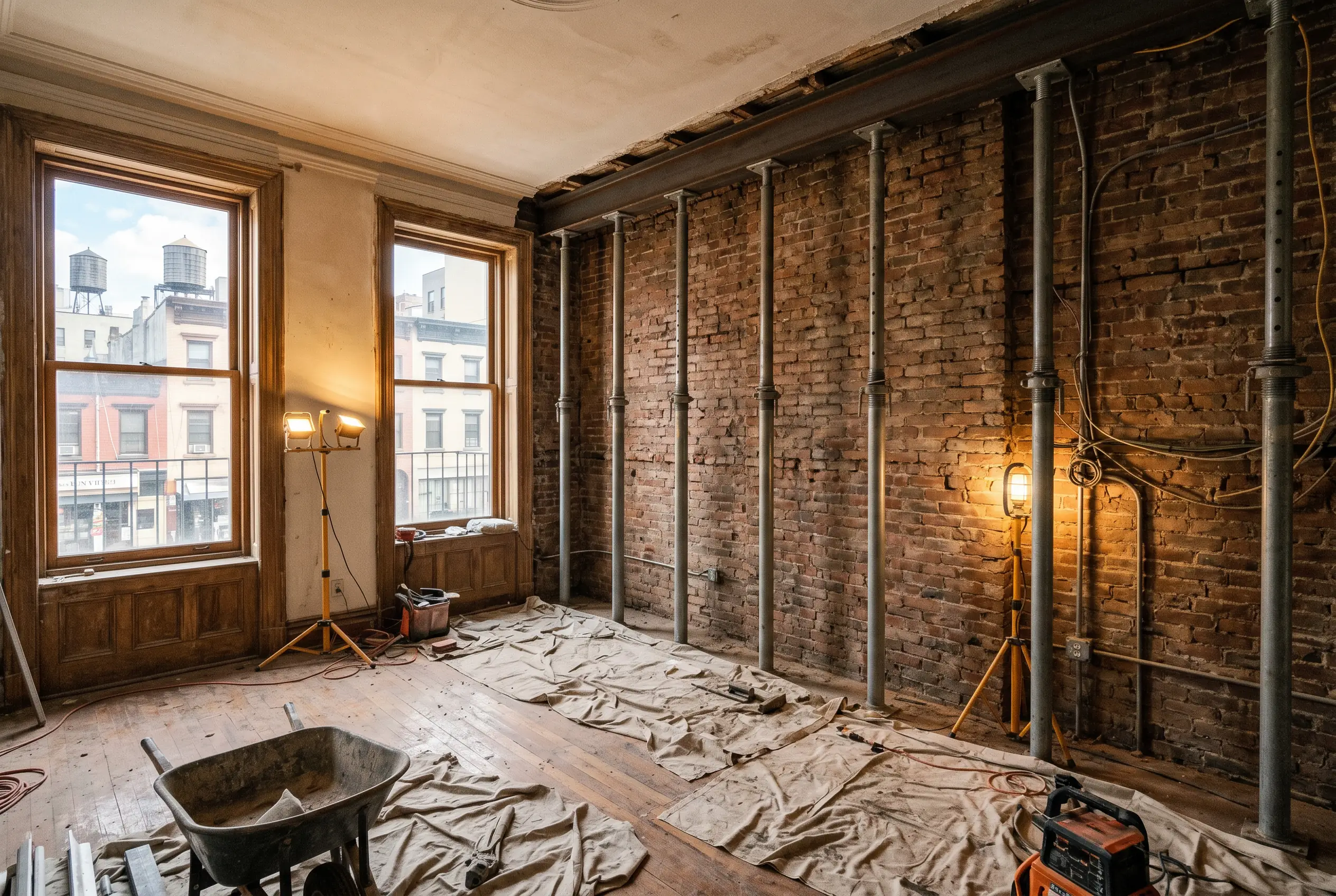
The Construction Logic Behind Pre-War Apartment Walls
Pre-war Manhattan apartment buildings were typically constructed using masonry bearing wall systems or early steel frame construction. In masonry bearing wall buildings, the exterior walls and many interior walls carry the weight of the floors and roof directly – there is no independent structural frame absorbing those loads. Interior walls in these buildings are often load-bearing regardless of their position in the floor plan, and their function is not always obvious from appearance alone.
In steel frame pre-war buildings, the primary structure is the steel column and beam grid, but interior masonry partitions and reinforced concrete elements can still carry significant loads depending on the original construction drawings and subsequent alterations over the decades. Many pre-war buildings have been modified multiple times since their original construction – walls added, walls removed, floor plans altered – and the cumulative structural history of a building is not something that can be assessed by visual inspection alone.
This is precisely why load-bearing wall removal in a pre-war Manhattan apartment is a job that begins with professional structural analysis, not with a contractor’s estimate.
Load-Bearing vs. Non-Load-Bearing: Why the Distinction Isn’t Always Obvious
In newer construction, there’s a useful rule of thumb: walls that run perpendicular to floor joists are more likely to be load-bearing. In pre-war Manhattan apartments, this heuristic falls apart quickly. The construction methods, the span directions, and the specific engineering of each building make generalization unreliable.
A wall that appears to be a simple partition – thin, finished in plaster, running parallel to what seems like a logical non-structural direction – may in fact be carrying significant loads from the floors above. Conversely, walls that look substantial may be purely cosmetic additions from a later renovation. The only reliable way to determine load-bearing status in a pre-war Manhattan building is through professional structural analysis, which involves reviewing original building drawings (available through the NYC Department of Buildings archives when they exist), assessing the construction type, and in many cases performing physical investigation to understand what’s actually happening within the wall assembly.

The Compounding Effect of Decades of Building History
Most pre-war Manhattan buildings are 80 to 100 years old, and few of them exist in their original configuration. Floor plans have been subdivided and recombined. Previous renovation work – some permitted, some not – has altered structural conditions in ways that original drawings cannot capture. Apartments have been combined vertically and horizontally. Mechanical systems have been rerouted, sometimes through load-bearing elements.
Before any structural alteration can proceed responsibly, the existing conditions need to be understood. This assessment is not something a general contractor can perform – it requires a licensed structural engineer who can interpret building history, evaluate existing conditions, and design a solution that accounts for the full structural picture of your specific apartment and building.
Regional Structural Variations: Brooklyn Brownstones to Westchester Estates
While Manhattan pre-war apartments are governed by DOB NOW filings and strict Co-op alteration agreements, residential structural demands shift significantly across neighboring luxury enclaves. In historic Brooklyn Heights and Park Slope, opening floor plans requires navigating shared brick party walls and sistering nineteenth-century joists under LPC oversight—detailed in our Brownstone Renovation Brooklyn & Manhattan Guide. Conversely, in suburban estates across Scarsdale and Bedford, structural wall removal frequently integrates heavy steel moment frames to support cathedral ceiling conversions, subject to local Architectural Review Boards (BAR)—covered in our Westchester Historic Estate Modernization Guide.
Structural Engineer Requirements for NYC Load-Bearing Wall Projects
In New York City, the involvement of a licensed structural engineer is not optional for load-bearing wall removal – it is required by law and enforced through the permit process. Understanding what that requirement actually means in practice helps homeowners plan their projects accurately from the beginning.

When a Licensed PE Is Required by NYC DOB
The New York City Department of Buildings requires that any work affecting the structural system of a building be designed and filed by a licensed Professional Engineer (PE) or Registered Architect (RA) with structural expertise. Load-bearing wall removal falls clearly within this category – it modifies the load path of the building and therefore requires professional engineering oversight at every stage.
This means that before a single wall can be opened, a licensed PE must review the existing structural conditions, design the replacement beam or header system that will carry the loads previously transferred through the wall, and prepare stamped engineering drawings that are submitted to the DOB as part of the permit application. The PE takes professional liability for the structural design – which is why this work cannot be delegated to a contractor, no matter how experienced.
In Manhattan co-op and condo buildings, the building’s own engineer or architect may also need to review and approve the structural plans before they are submitted to the DOB. Many buildings require this as part of their alteration agreement process, adding another layer of review that is separate from – but parallel to – the DOB permit process.
What a Structural Engineer Does on a Manhattan Wall Removal Project
The structural engineer’s role extends well beyond producing drawings for the permit application. In a typical pre-war apartment load-bearing wall removal project, the PE’s work includes:
- Existing condition assessment – reviewing available building drawings, visiting the site to evaluate the construction type and wall assembly, and determining the loads that the wall currently carries
- Structural design – calculating the required size and specification of the replacement beam or header, designing the new column or post supports at the beam ends, and specifying any required reinforcement of the floor structure above
- Drawing preparation – producing stamped engineering drawings that show the existing conditions, the proposed work, the structural details for the new beam and supports, and any required reinforcement
- DOB filing coordination – working with the filing architect to ensure the structural drawings are correctly integrated into the overall permit application
- Construction observation – visiting the site during demolition to verify that actual conditions match the design assumptions, and again after installation to confirm that the structural work was executed correctly
This last point is one that many homeowners underestimate. The construction observation visits are not a formality – they are the engineer’s professional responsibility to confirm that the work as built matches the approved design. Skipping these visits is not an option on a permitted structural project.
The Engineering Documents You Need for DOB Permit Approval
The structural documentation package for a load-bearing wall removal permit typically includes stamped structural drawings showing the existing and proposed conditions, a beam calculation document demonstrating that the replacement element is adequately sized, connection details for the beam-to-column and beam-to-floor connections, and – in many cases – a letter of responsibility from the PE accepting professional responsibility for the design.
When the project also involves any changes to the building’s lateral resistance system – which is uncommon in apartment-level alterations but possible in certain configurations – additional documentation is required. Your structural engineer will identify whether this applies to your project during the initial assessment.
At KS Renovation Group, we coordinate directly with licensed structural engineers who have extensive experience in Manhattan pre-war buildings. We manage the engineering coordination process so that homeowners are not navigating the technical and administrative requirements on their own. Reach out to our team to learn how we handle the structural engineering process for load-bearing wall projects.
The NYC DOB Permit Process for Load-Bearing Wall Removal
The permit process for structural work in a Manhattan apartment is more involved than most homeowners expect, and the timeline it creates needs to be factored into project planning well in advance. Understanding the process before you begin prevents the delays and complications that arise when structural projects are approached without adequate preparation.
Alteration Type 1 vs. Alteration Type 2 – Which Permit Do You Need?
The NYC Department of Buildings classifies building alterations into types based on the scope and nature of the work. For load-bearing wall removal in a Manhattan apartment, the relevant categories are:
Alteration Type 1 (Alt 1) covers work that changes the use, egress, or occupancy of a space – for example, combining two apartments, changing a residential unit to a commercial use, or significantly altering the means of egress. Load-bearing wall removal that is part of an apartment combination or that affects egress conditions falls into this category.
Alteration Type 2 (Alt 2) covers work that alters the building structure without changing use or egress. Most stand-alone load-bearing wall removal projects within a single apartment fall here – the structural work is significant, but the apartment remains a residential unit with the same egress configuration.
The distinction matters because Alt 1 applications require a more extensive review process and may trigger additional requirements. Misclassifying a project – filing as Alt 2 when the scope requires Alt 1 – creates significant complications after the fact. Our team works with experienced filing architects who assess permit classification correctly at the outset.
Co-Op and Condo Board Approval Requirements
Beyond the NYC DOB permit, virtually every Manhattan co-op and condo building requires board review and approval for structural renovation work. The specific requirements vary building by building, but structural alterations – especially load-bearing wall removal – are almost universally considered major alterations requiring formal board approval.
The typical co-op or condo board submission for a structural project includes renovation plans stamped by a licensed architect and engineer, a contractor qualification package, certificates of insurance meeting the building’s specific requirements, a renovation deposit and escrow arrangement, and a signed alteration agreement specifying the terms under which the renovation will be conducted. Buildings with older structures may require that the building’s own engineer review and sign off on the structural plans before the board will grant approval.
The board approval timeline varies considerably – some buildings with active boards and clear alteration agreements can turn around approvals within four to six weeks, while buildings with less structured processes can take several months. Planning a structural renovation in a Manhattan co-op without factoring in realistic board approval timelines is a common mistake that derails project schedules.
Timeline for Structural Permits in Manhattan
The honest answer about structural permit timelines in Manhattan is that they require patience and early planning. A realistic timeline for a load-bearing wall removal project from initial structural assessment through permit issuance runs twelve to twenty weeks when all parties are moving efficiently – longer if there are plan examination comments requiring responses, board approval delays, or complications in the existing conditions assessment.
This timeline breaks down roughly as follows: initial structural assessment and design typically requires two to four weeks; preparation of permit documents (engineering drawings, architectural drawings, filing package) takes another three to five weeks; DOB plan examination adds four to eight weeks depending on current processing times and whether the application goes through standard or expedited review; and co-op board approval runs in parallel with the DOB process but may extend beyond it.
The practical implication is that if you want to begin structural demolition in the fall, your planning process needs to begin no later than early summer. Projects that begin the permitting process in September with the expectation of starting construction by October routinely find themselves waiting until the following year. This is not a reflection of slow permitting – it is the reality of the regulatory complexity involved in structural work in Manhattan buildings. Contact KS Renovation Group now to begin the planning process for your fall renovation.
Executing the Load-Bearing Wall Removal: From Beam Selection to Finished Space
With engineering complete and permits in hand, the physical work of opening a load-bearing wall can begin. This phase of the project has its own technical requirements and decision points that shape both the structural outcome and the finished look of the space.
Beam and Header Selection for Pre-War Apartments
The beam or header that replaces a load-bearing wall is the most consequential structural decision in the project. It must be adequately sized to carry the loads from above – including the weight of the floors, the walls, and everything on them through the floors above – and it must be designed to deflect within acceptable limits so that the floor structure above does not crack plaster, bind doors, or create noticeable sag over time.
In pre-war Manhattan apartments, beam selection involves additional considerations. The beam must fit within the ceiling height available without creating an objectionable visual interruption, which may require flush-beam details where the structural member is set within the floor assembly rather than hanging below the ceiling. Steel beams are frequently specified for spanning wide openings because they achieve greater strength in a shallower profile than wood, which is important when ceiling height is limited. In some cases, engineered lumber products – LVL (laminated veneer lumber) or parallel strand lumber – offer a viable alternative to steel with comparable performance and easier installation logistics in buildings with restricted elevator access.
The beam ends transfer loads to the structure below through new posts or columns, which must bear on adequate structure at each end. In pre-war masonry buildings, the masonry walls and columns at the beam bearing points are generally robust. In framed construction, new posts may need to be added and their loads transferred through the floor structure to foundations below – a detail the structural engineer designs specifically for each project.

Temporary Shoring and the Demolition Sequence
Before an existing load-bearing wall can be removed, the loads it carries must be temporarily transferred to an alternative support system. This temporary shoring – a system of posts, beams, and bearing points designed to hold the floor above while the permanent wall is removed and the new beam is installed – must itself be designed to adequately carry the loads involved.
Temporary shoring for a load-bearing wall removal is typically not a complex engineering problem, but it is a non-negotiable step. Removing a load-bearing wall without adequate temporary shoring is one of the most dangerous things that can happen on a residential renovation project, and it is the kind of shortcut that inexperienced contractors sometimes attempt. The consequences range from cracked finishes in apartments above to catastrophic structural failure. On a properly managed project, temporary shoring is installed before demolition begins, inspected, and maintained until the new permanent beam is installed and confirmed to be bearing correctly.
Integrating the New Opening into Your Finished Design
Once the structural work is complete and the new beam is in place, the transformation of the space can begin. The new opening needs to be integrated into the finished design of the apartment – and this is where the design expertise at KS Renovation Group adds significant value.
The beam – whether exposed or concealed – needs to be addressed architecturally. Exposed steel beams have become a popular design choice in loft-style Manhattan apartments, and the industrial quality of a steel W-section beam can become a deliberate design feature rather than a structural necessity to hide. In more traditional pre-war interiors, concealing the beam within a flush soffit or a built-out ceiling detail keeps the focus on the newly opened space rather than the structural element above.
Column and post details at the beam ends also require design attention. The new support elements need to be integrated into the room’s architecture – whether as freestanding columns that become part of the interior composition, as elements built into cabinetry or millwork runs, or as thin steel posts that nearly disappear in the new open plan. KS Renovation Group’s custom millwork capabilities make these integrations particularly clean – new cabinetry, shelving, or built-in storage can be designed around the structural requirements, turning structural necessities into designed features.
Flooring, trim, paint, and plaster repairs complete the transformation. When a wall is removed in a pre-war Manhattan apartment, the floor where the wall stood typically shows a gap or a change in the floor finish that needs to be addressed. In apartments with original oak hardwood floors, matching the existing finish is one of the more nuanced challenges – we work with experienced flooring specialists who can integrate new material with the existing floor in a way that minimizes the visual seam. Explore KS Renovation Group’s portfolio to see examples of pre-war structural renovations we’ve completed.
Conclusion
Opening a load-bearing wall in a pre-war Manhattan apartment is one of the most transformative renovations a homeowner can undertake – and one of the most complex to execute correctly. The structural engineering requirements, the NYC DOB permit process, and the co-op board approval sequence are not obstacles to be worked around. They are the framework that ensures the work is done safely, legally, and with results that hold up over the life of your apartment.
The homeowners who achieve the best outcomes in structural renovation projects are the ones who begin the process early, partner with experienced professionals, and approach the timeline with realistic expectations. The paperwork and the permits are not the interesting part of the project – but they are the foundation on which everything else depends.
KS Renovation Group has extensive experience managing the full process of load-bearing wall removal in Manhattan pre-war apartments, from initial structural assessment through engineering coordination, permit filing, co-op board documentation, and finished construction. If you’re envisioning a more open, connected floor plan in your apartment, exploring our pre-war structural and gut renovation services helps ensure every engineering requirement is addressed from day one. Summer 2026 is the right moment to begin planning for a fall transformation. Contact KS Renovation Group today to schedule a consultation with our structural renovation specialists.
}, {“@type”: “Question”, “name”: “Can I remove a load-bearing wall in a Manhattan co-op without board approval?”, “acceptedAnswer”: {“@type”: “Answer”, “text”: “No. Virtually all Manhattan co-op buildings require formal board approval for structural alterations, and load-bearing wall removal is universally considered a major structural alteration. Attempting to proceed without board approval – or misrepresenting the scope of work to avoid triggering the approval process – violates the alteration agreement and can result in work stoppages, required restoration of the original conditions at the owner’s expense, and legal consequences. The board approval process, while requiring time and documentation, is a manageable step when the project is properly prepared from the beginning.”}}, {“@type”: “Question”, “name”: “How long does it take to get a structural permit for load-bearing wall removal in NYC?”, “acceptedAnswer”: {“@type”: “Answer”, “text”: “realistic timeline from initial structural assessment through permit issuance runs twelve to twenty weeks when the project is well-prepared and processing proceeds without significant complications. This includes time for structural engineering and drawing preparation (two to five weeks), preparation of the full filing package (two to four weeks), and DOB plan examination (four to eight weeks depending on current processing times). Co-op board approval runs in parallel but may extend the overall timeline if the building’s process is lengthy. Beginning the permit process in early summer for a fall construction start is strongly recommended.”}}, {“@type”: “Question”, “name”: “Does the new beam always need to be visible, or can it be hidden in the ceiling?”, “acceptedAnswer”: {“@type”: “Answer”, “text”: “In many cases, the new beam can be concealed within a ceiling soffit or integrated flush with the floor structure above, eliminating any visible interruption at ceiling level. Whether this is possible depends on the available ceiling height, the size of the beam required by the structural calculations, and the construction of the floor assembly above. Steel beams in particular can achieve the required structural capacity in a shallower profile than comparable wood beams, which makes concealment more achievable when ceiling height is limited. Your structural engineer and the KS Renovation Group design team will evaluate the options for your specific project and ceiling conditions.”}}, {“@type”: “Question”, “name”: “What happens to the flooring where the load-bearing wall used to be?”, “acceptedAnswer”: {“@type”: “Answer”, “text”: “When a wall is removed, the floor beneath it typically shows a gap, a transition strip from an old flooring installation, or a change in the floor finish where different materials met under the wall. In pre-war Manhattan apartments with original hardwood floors, addressing this seamlessly requires skilled flooring work – often involving cutting in new material, weaving new boards into the existing pattern, and refinishing the full room so that the repair blends invisibly with the original floor. KS Renovation Group coordinates experienced flooring specialists for this work as part of every structural renovation project, ensuring that the finished floor reads as a continuous surface throughout the newly opened space.”}}]}
Frequently Asked Questions
1. How do I know if the wall I want to remove is load-bearing in my Manhattan apartment?
The only reliable way to determine load-bearing status in a pre-war Manhattan apartment is through professional structural assessment. Visual inspection and general rules of thumb are not sufficient in pre-war construction because the load paths in masonry bearing wall and early steel frame buildings do not follow the patterns that apply in newer construction. A licensed structural engineer will review available building drawings, assess the construction type, and in many cases perform physical investigation to determine definitively whether the wall is load-bearing and what loads it carries. KS Renovation Group coordinates this assessment as part of our pre-project evaluation process.
2. Can I remove a load-bearing wall in a Manhattan co-op without board approval?
No. Virtually all Manhattan co-op buildings require formal board approval for structural alterations, and load-bearing wall removal is universally considered a major structural alteration. Attempting to proceed without board approval – or misrepresenting the scope of work to avoid triggering the approval process – violates the alteration agreement and can result in work stoppages, required restoration of the original conditions at the owner’s expense, and legal consequences. The board approval process, while requiring time and documentation, is a manageable step when the project is properly prepared from the beginning.
3. How long does it take to get a structural permit for load-bearing wall removal in NYC?
A realistic timeline from initial structural assessment through permit issuance runs twelve to twenty weeks when the project is well-prepared and processing proceeds without significant complications. This includes time for structural engineering and drawing preparation (two to five weeks), preparation of the full filing package (two to four weeks), and DOB plan examination (four to eight weeks depending on current processing times). Co-op board approval runs in parallel but may extend the overall timeline if the building’s process is lengthy. Beginning the permit process in early summer for a fall construction start is strongly recommended.
4. Does the new beam always need to be visible, or can it be hidden in the ceiling?
In many cases, the new beam can be concealed within a ceiling soffit or integrated flush with the floor structure above, eliminating any visible interruption at ceiling level. Whether this is possible depends on the available ceiling height, the size of the beam required by the structural calculations, and the construction of the floor assembly above. Steel beams in particular can achieve the required structural capacity in a shallower profile than comparable wood beams, which makes concealment more achievable when ceiling height is limited. Your structural engineer and the KS Renovation Group design team will evaluate the options for your specific project and ceiling conditions.
5. What happens to the flooring where the load-bearing wall used to be?
When a wall is removed, the floor beneath it typically shows a gap, a transition strip from an old flooring installation, or a change in the floor finish where different materials met under the wall. In pre-war Manhattan apartments with original hardwood floors, addressing this seamlessly requires skilled flooring work – often involving cutting in new material, weaving new boards into the existing pattern, and refinishing the full room so that the repair blends invisibly with the original floor. KS Renovation Group coordinates experienced flooring specialists for this work as part of every structural renovation project, ensuring that the finished floor reads as a continuous surface throughout the newly opened space. Planning an upcoming residential transformation in New York City? Explore our specialized contact KS Renovation Group or reach out to discuss your project specifications.