
Home Gym Design for Manhattan Apartments: Luxury Home Fitness Room Guide
The wellness conversation in Manhattan has shifted decisively. What began as a pandemic-era workaround - clearing furniture from a spare room to make space for a yoga mat -0 has become something far more intentional. In 2026, a dedicated home fitness space is among the most requested features in Manhattan luxury renovation projects, and the homeowners asking for it are not looking for a corner with a folding bike. They want a proper gym: thoughtfully designed, architecturally integrated, and built to function at the same level as every other room in their apartment.
The challenge, of course, is Manhattan real estate. A 2,000-square-foot apartment on the Upper West Side is generous by New York standards - but asking it to accommodate a dedicated fitness room alongside a kitchen, living areas, bedrooms, and storage requires design thinking that goes well beyond buying equipment and painting a wall.
This is exactly the kind problem that KS Renovation Group solves every day. A home gym in a Manhattan apartment is not simply a construction project. It's a design challenge involving structural considerations, building rules, ventilation, acoustic engineering, and custom millwork - all executed within the constraints of a co-op or condo alteration agreement. Getting it right rewards you with a room that performs at a high level and adds genuine value to one of the most expensive residential assets in the world.
Explore KS Renovation Group's approach to full apartment renovations and see how we transform underused spaces into rooms that earn their square footage.

Choosing the Right Equipment for a Manhattan Home Gym

Multi-Function Over Single-Purpose
In a Manhattan apartment, every piece of equipment must justify its footprint. The gym design conversation almost always starts here - not with flooring or mirrors, but with an honest inventory of how the space will actually be used.
The era of the dedicated single-function machine is largely over in residential fitness design. A commercial leg press or a fixed-weight rack system consumes floor area disproportionate to what it delivers in a home setting. The Manhattan home gym of 2026 is built around multi-function equipment: adjustable cable machines that replace eight separate stations, power racks with integrated storage, folding wall-mounted pull-up rigs that disappear when not in use. The goal is maximum training versatility from minimum square footage.
Technogym, whose equipment is found in some of the most demanding luxury residential projects in New York and globally, has built its product line around exactly this brief: compact, beautiful, and fully functional for serious training. Their modular systems are designed with apartment environments in mind - which matters when you're specifying equipment for a pre-war Upper East Side co-op rather than a suburban basement.
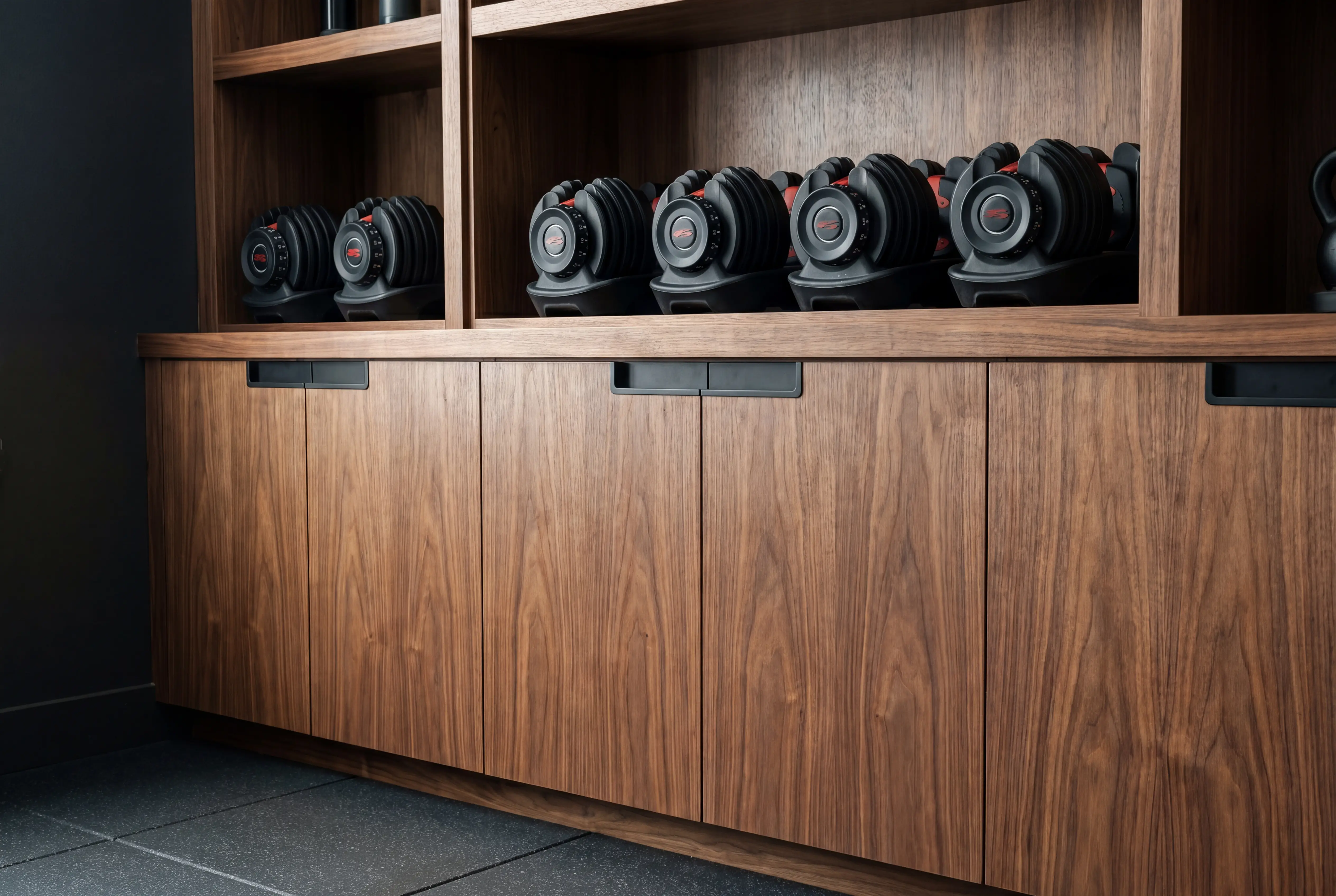
Free weights remain irreplaceable in any serious home gym, but the implementation matters. Fixed dumbbell sets in traditional racks consume considerable wall space and look institutional. Adjustable dumbbell systems - in which a single handle mechanism replaces an entire rack of weights - are the standard solution for Manhattan apartments. Combined with a quality adjustable bench, an adjustable dumbbell system gives a serious lifter the equivalent of a commercial free weight section in a footprint smaller than most Manhattan kitchen islands.
Smart Fitness Technology and the Wall-Mounted Revolution
The transformation of home fitness technology in the past five years has been particularly relevant to apartment gym design. A category of wall-mounted, space-efficient fitness systems - Tonal being the best-known example - now delivers a full strength training system in a footprint that occupies approximately the wall space of a large framed print. When not in use, these systems fold flat. The visual presence in the room is minimal; the training capability is remarkable.
For cardiovascular training, compact design has also improved substantially. Peloton's Bike+ occupies roughly four square feet of floor space - comparable to a side chair. Folding treadmills from brands like NordicTrack and Bowflex store vertically when not in use. Rowing machines, which provide one of the most complete cardiovascular and strength workouts available, store on end or on wall mounts.
The most sophisticated Manhattan home gyms are now designed with these systems in mind from the beginning - with custom millwork built to integrate wall-mounted equipment cleanly, conceal cables and charging infrastructure, and store accessories without visual clutter. Contact KS Renovation Group to discuss how we design custom storage and millwork around your specific equipment selection.
Planning for Cardio, Strength, and Recovery
The most complete home gyms address three training categories: cardiovascular conditioning, strength training, and recovery. In a Manhattan apartment, recovery space is often the first element cut from a gym plan - and consistently the one clients most wish they had included. A recovery corner with a foam rolling area, a wall-mounted stretching rig, or - in larger fitness rooms - a compact infrared sauna or contrast shower represents the premium tier of residential fitness design that is increasingly requested in Manhattan's most significant renovation projects.

Not every apartment gym will accommodate all three categories at scale. But designing with recovery in mind from the beginning - even if initial execution is limited - ensures the room remains functional as the homeowner's training priorities evolve.
Flooring and Mirrors: The Visual and Functional Foundation
Flooring That Performs and Protects
Home gym flooring in a Manhattan apartment serves three distinct functions: it protects the structural floor from equipment impact, it provides appropriate traction and cushioning for training, and it contributes to the room's acoustic performance. Choosing gym flooring that accomplishes all three requires understanding both the training use case and the building context.
Rubber flooring is the standard for serious home gyms, and for good reason. High-density vulcanized rubber - the kind used in commercial fitness facilities - absorbs the impact of dropped weights, protects the underlying subfloor, provides excellent traction under load, and contributes meaningfully to sound attenuation. It is available in formats from interlocking tiles to rolled sheets, and in a range of thicknesses from 8mm (suitable for yoga and stretching areas) to 20mm+ (appropriate for heavy free weight zones).
In Manhattan co-op and condo apartments, protecting the structural floor from equipment damage is not just a design preference - it is often a condition of the building's alteration agreement. Co-op boards are legitimately concerned about the impact of heavy gym equipment on ceiling finishes in the apartment below, and an appropriately specified rubber floor system addresses that concern directly. KS Renovation Group consistently recommends a minimum 10mm rubber tile system under any free weight area, with additional acoustic underlayment beneath when the building specifies impact noise requirements.
For mixed-use rooms where the gym aesthetic needs to coexist with other functions, cork underlayment beneath a hardwood or engineered wood floor offers a quieter alternative. Cork provides meaningful acoustic isolation and thermal comfort while maintaining a residential visual character that works for rooms that serve as both workout space and, for example, home office or meditation room.
Mirrors: Function, Light, and the Psychology of Space
Full-length mirrors are among the highest-value additions in any Manhattan home gym, and not primarily for aesthetic reasons. Proper mirror placement lets a training athlete check form during movements - a function that significantly improves both training effectiveness and injury prevention when training without a coach.
In a compact Manhattan gym, mirrors also do something architecturally valuable: they visually double the perceived space. A room that is 12 by 14 feet with mirror coverage on one full wall reads meaningfully larger than its actual dimensions. In a city where square footage is the defining constraint of home design, this is not a trivial benefit.
Mirror specification for gym applications requires attention to thickness and mounting method. Standard decorative mirrors are not appropriate for wall-to-wall gym applications - they are too fragile for environments where equipment may make contact, and inadequate mounting creates safety risk. Gym-specification mirrors at 6mm or thicker, properly backed and mounted to wall framing (not just drywall), are the correct solution. KS Renovation Group's millwork team integrates mirror panels into custom gym wall systems that provide secure mounting, clean reveals at edges and corners, and the ability to conceal structural elements behind a finished wall plane.
Natural light is a meaningful consideration in gym design as well. A north-facing room with limited windows can be transformed by well-designed artificial lighting that replicates the full-spectrum character of natural light - particularly important in fitness spaces where energy and motivation have a physiological basis in light quality. Publications like Dezeen have written extensively about the integration of lighting design and wellness spaces in residential architecture, and the findings translate directly to Manhattan apartment gym design.
Ventilation and Soundproofing: The NYC Building Reality
Ventilation in a Closed Fitness Space
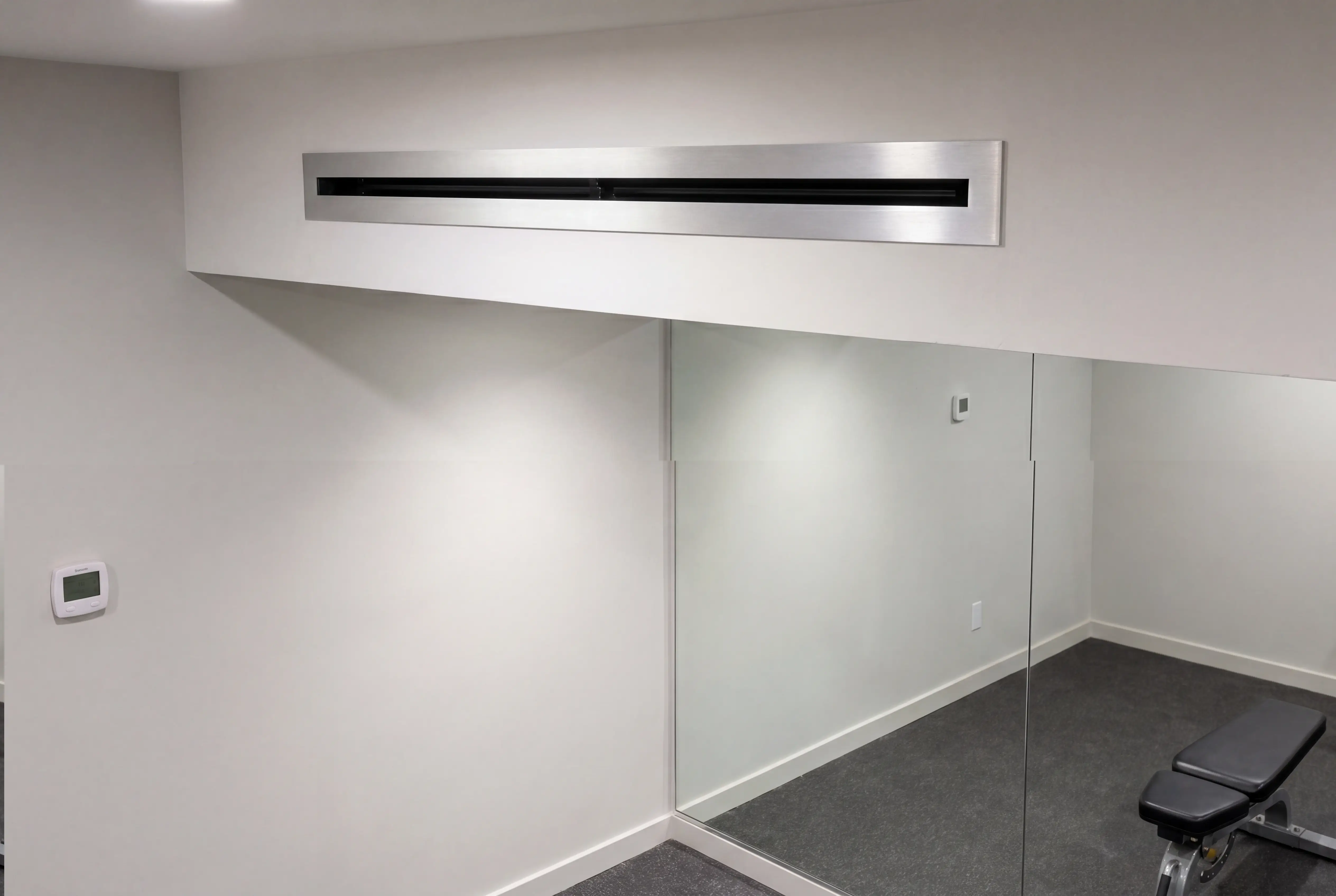
A closed room with active exercise generates significant heat and moisture. In a Manhattan apartment, where rooms are often interior-facing with limited operable window area, inadequate ventilation in a gym space creates both comfort and air quality problems that make the room genuinely unpleasant to train in - regardless of how well it is otherwise designed.
The solution is mechanical ventilation designed specifically for the expected load. A compact Energy Recovery Ventilator (ERV) or Heat Recovery Ventilator (HRV) provides continuous fresh air exchange while recovering thermal energy from the exhaust stream - an important efficiency consideration in a city where heating and cooling costs are significant. In pre-war Manhattan apartments, integrating new mechanical ventilation requires working within existing shaft configurations and building rules around exterior penetrations. KS Renovation Group coordinates these mechanical decisions with licensed HVAC contractors who specialize in Manhattan apartment environments.
Air quality in fitness spaces benefits from filtration beyond standard HVAC performance. HEPA-grade filtration removes airborne particulates from rubber flooring, equipment materials, and the increased respiration of active exercise. The WELL Building Standard, increasingly referenced in luxury residential design, provides a useful framework for thinking about fitness space air quality even outside formal certification contexts.
Soundproofing: Protecting Your Neighbors and Your Co-op Standing
Of all the design challenges in a Manhattan home gym, soundproofing is the one most likely to determine whether the project proceeds smoothly through the building approval process - and whether it creates problems after completion.
Impact noise - the low-frequency vibration transmitted through the floor structure when weights are dropped, when feet land from jumps, or when cardio equipment operates - is the primary concern in Manhattan co-op and condo buildings. Unlike airborne sound, which can be addressed with wall and ceiling treatment, impact noise travels through the building structure and is significantly harder to attenuate after the fact.
The standard approach to impact noise mitigation in a Manhattan apartment gym involves a decoupled floor system: the gym floor is constructed on resilient mounts or a specialized acoustic underlayment that interrupts the transmission path between the gym floor and the building structure. Products specifically designed for this application - including Kinetics Noise Control isolation pads and similar systems used in commercial and residential acoustic projects - can provide substantial impact isolation when installed correctly as part of a new floor construction.
Airborne sound - voices, music, the motor noise of cardio equipment - is addressed through standard acoustic treatment: dense insulation within wall and ceiling cavities, resilient channel mounting for drywall that decouples the finish surface from the framing, and acoustic caulk at all penetrations. A properly executed sound isolation scope can bring a Manhattan home gym into acoustic compliance with virtually any co-op or condo building's alteration requirements.
The NYC Department of Buildings does not typically require permits for acoustic treatment or gym floor installation alone, but any structural modification - new partitions, ceiling drops, HVAC penetrations - requires filing. KS Renovation Group manages the full permit and co-op approval process, ensuring that every element of the gym design is properly authorized before work begins.
Custom Millwork and Storage: The Detail That Separates a Gym from a Room
Built-In Storage That Eliminates Visual Clutter
The difference between a Manhattan home gym that looks like a fitness facility and one that looks like a storage problem waiting to happen almost always comes down to storage design. Gym accessories accumulate: resistance bands, foam rollers, jump ropes, kettlebells, weight plates, yoga mats, gloves, water bottles, towels. Without purpose-built storage, these objects colonize every horizontal surface and floor corner in the room, making it impossible for the space to read as the premium room it should be.
Custom millwork solves this completely. A wall-mounted cabinetry system designed specifically for the equipment inventory of the gym - with dedicated slots for every accessory category, adjustable shelving for equipment that changes over time, closed cabinet sections for items that should be out of sight - transforms the visual character of a gym space from improvised to intentional. When the training is done and the doors are closed, the room can present as a clean, architectural space rather than a sporting goods storage area.
KS Renovation Group fabricates all millwork in our own facility, which means gym storage systems are built to the same standard as the custom kitchen cabinetry and bedroom closet systems we produce for the same apartments. The material palette can match other rooms in the apartment - the same walnut, the same painted finish, the same hardware - creating a coherent design language across the home rather than the institutional look that off-the-shelf gym storage inevitably produces. Schedule a consultation to see how custom millwork transforms a home gym from functional to exceptional.

The Multi-Use Room: When the Gym Has to Share
Manhattan apartments often cannot dedicate a room exclusively to fitness. A second bedroom that needs to function as both a guest room and a home gym, or a home office that doubles as a workout space, is a common brief - and one that custom millwork handles with particular elegance.
Murphy bed systems integrated into a custom millwork wall allow a guest room to present as a proper bedroom when in use while revealing the gym floor and mirror wall when the bed is folded away. Equipment storage concealed behind cabinet doors means that the room reads as a study or bedroom when guests are present. The hardware and finish quality of the millwork ensures that the transition between functions feels considered rather than improvised.
Remodelista has documented numerous examples of sophisticated multi-function rooms in urban apartments, and the common thread in the most successful examples is always the quality of the built-in storage system. When the millwork is right, the room can hold two programs simultaneously without either one compromising the other.
For Manhattan apartments where a dedicated fitness room is not possible, this approach - a thoughtfully designed multi-use room with custom millwork - often delivers more value than a pure gym room would, because it extends the usefulness of every square foot it occupies. That is, in the end, the essential principle of luxury Manhattan design.
Conclusion: The Home Gym Is Now a Permanent Fixture of Manhattan Luxury Living
The home gym has completed its transition from a pandemic contingency to a permanent expectation in Manhattan luxury apartments. For homeowners planning renovations in 2026, fitness space is not an afterthought - it is a design brief with the same complexity and the same reward potential as a kitchen or bathroom renovation.
Done well, a Manhattan home gym is a room that compounds in value. It changes daily routines, eliminates the friction of commercial gym membership, and adds a category of functionality to the apartment that the luxury market increasingly treats as essential. It is also a design achievement: a room that demonstrates the same level of craft and intention as every other space in a KS Renovation Group project.
The equipment selection, the flooring, the mirrors, the ventilation, the acoustic engineering, and the custom millwork all contribute to a room that functions at the highest level - and that reads, unmistakably, as the work of people who understand what a well-designed Manhattan apartment looks like.
Contact KS Renovation Group to discuss your home gym project - from initial concept through co-op approval, permit filing, and final installation.
Frequently Asked Questions
How much space do you actually need for a home gym in a Manhattan apartment?
A functional home gym can be designed in as little as 80-100 square feet - approximately the footprint of a large walk-in closet. At this scale, the focus is on multi-function equipment (an adjustable cable system or smart wall-mounted unit, adjustable dumbbells, a compact cardio option), quality flooring, and mirror coverage. For a more comprehensive fitness space that accommodates a range of training types, 150-200 square feet allows meaningful expansion of both equipment and floor space for movement. The key in any Manhattan apartment is equipment selection and storage design - not raw square footage.
Do I need a permit or co-op approval to build a home gym in my Manhattan apartment?
Whether permits are required depends on the scope of the project. Flooring replacement, mirror installation, and equipment setup typically do not require NYC DOB permits. However, any work involving new walls, ceiling modifications, HVAC changes, or electrical upgrades requires filing with the DOB. Separately, most co-op and condo alteration agreements require written approval from the building's managing agent or board before any renovation work begins - including gym installations that involve structural floor systems or mechanical ventilation. KS Renovation Group manages the full approval and permitting process on behalf of every client.
What is the best flooring for a home gym in a Manhattan apartment?
High-density rubber flooring - either interlocking tiles or rolled sheet rubber - is the standard for most home gym applications. It protects the structural subfloor, provides appropriate training traction, and contributes to impact sound attenuation. Thickness matters: 10mm minimum for cardio and light weight areas, 15-20mm for free weight zones. Where the gym doubles as a living space, cork underlayment beneath a hardwood or engineered wood floor provides a quieter, more residential alternative. The right choice depends on training type, building requirements, and the visual character of the room.
How do you soundproof a home gym so it doesn't disturb neighbors in a co-op building?
Effective soundproofing in a Manhattan home gym addresses two types of noise separately. Impact noise - from weights, cardio equipment, and foot traffic - is managed through a decoupled floor system built on resilient isolation mounts or acoustic underlayment that interrupts vibration transmission through the building structure. Airborne noise - music, voices, equipment motors - is addressed through dense insulation in wall and ceiling cavities, resilient channel mounting for drywall, and acoustic caulk at all penetrations. A properly executed acoustic scope can meet virtually any co-op building's requirements and should be designed in coordination with the building's alteration agreement before work begins.
Can custom millwork make a small home gym feel larger and more functional?
Significantly. Purpose-built millwork in a home gym does several things that off-the-shelf solutions cannot: it eliminates the visual clutter of loose accessories, creates dedicated storage for every equipment category, and allows the room to read as a finished architectural space rather than an improvised fitness area. Mirror panels integrated into a custom millwork wall system visually expand the space while providing the structural mounting quality that gym applications require. For multi-use rooms - gym/guest room or gym/home office - custom millwork makes the dual-program layout possible in a way that feels intentional rather than compromised. KS Renovation Group fabricates all millwork in-house, which means gym storage systems are built to the same standard as every other element of your renovation.

You may also be interested

KS Renovation Blog
Get Inspired
Meaningful information about home remodeling for the true NYC homeowners.

OUr Clients Say

William Plotch
amy schorr
gberaka
NYC kitchen remodeling Projects and more


