
FSC-Certified Wood for Sustainable Manhattan Renovations
June 5 is World Environment Day, and in Manhattan’s luxury renovation market, the conversation about material sourcing has shifted decisively from aspiration to expectation. In 2026, the homeowners planning significant apartment renovations are not only asking about finishes, layouts, and timelines - they are asking where the wood in their kitchen cabinets comes from, whether the lumber in their custom built-ins was harvested responsibly, and whether their renovation contributes to or detracts from global forest health. These are serious questions, and they deserve serious answers.
The demand for environmental accountability in luxury interiors is not a passing trend. Industry research consistently shows that high-net-worth buyers and renters in Manhattan are placing increasing weight on sustainability credentials when evaluating properties. Buildings pursuing LEED certification are commanding premium valuations. Design publications like Remodelista and Dezeen have covered the rise of responsible sourcing in luxury interiors extensively, and what was once a niche preference has become a mainstream expectation in the top tier of the Manhattan market.
At the center of responsible wood sourcing is a single certification that has become the global standard: FSC. For Manhattan homeowners investing in custom millwork, cabinetry, flooring, and built-in storage, understanding what FSC certification means - and how it shapes the materials in your renovation - is the starting point for building a home that reflects both your aesthetic values and your environmental ones.
At KS Renovation Group, we believe that luxury renovation and environmental responsibility are not competing priorities. Our commitment to FSC-certified wood throughout our custom millwork and cabinetry ensures that the work we build in your Manhattan apartment is crafted from materials sourced with integrity. Contact our team to discuss how sustainable millwork can be integrated into your renovation project.

What FSC Certification Means for Manhattan Renovation Materials
The Forest Stewardship Council (FSC) certification is the most rigorous and widely recognized standard for responsible forest management in the world. But what does that certification actually mean, how does it function in practice, and why should Manhattan homeowners care about it when selecting materials for an apartment renovation?

The Forest Stewardship Council Standard Explained
The Forest Stewardship Council is an international non-profit organization founded in 1993 in response to growing concern about global deforestation and the destruction of forest ecosystems. FSC developed a comprehensive set of forest management standards that define what responsible forestry looks like across environmental, social, and economic dimensions.
To earn FSC certification, a forest operation must demonstrate compliance with ten principles and dozens of specific criteria covering topics including biodiversity conservation, protection of indigenous peoples’ rights, worker safety and fair wages, prohibition of conversion of natural forests to plantations, and maintenance of high conservation value areas. Certification is granted and monitored by independent third-party organizations - not by FSC itself and not by the timber producer - which eliminates the self-certification problem that plagues many “green” labeling schemes.
There are two primary FSC certification types relevant to renovation materials. FSC Forest Management certification applies to the forest operation itself and verifies that the timber was harvested according to FSC’s standards. FSC Chain of Custody certification applies to companies throughout the supply chain - sawmills, manufacturers, distributors, and fabricators - and verifies that FSC-certified material has been tracked and maintained separately from non-certified material at every step between the forest and the finished product. Both certifications are required to make a credible FSC claim on a finished product like a kitchen cabinet door or a hardwood floor plank.
Chain of Custody: Tracking Certified Wood from Forest to Manhattan Apartment
The concept of chain of custody is what separates FSC certification from the vague sustainability claims that pervade the building materials industry. A product can legitimately carry the FSC label only if every link in the supply chain - from the certified forest through every processing and manufacturing step to the finished product - has maintained FSC Chain of Custody certification and has documented the flow of certified material through its operations.
For a custom Manhattan kitchen cabinet, this means the lumber supplier, the panel manufacturer (if engineered wood products are used), the finishing material supplier, and the millwork fabricator all need to hold current FSC Chain of Custody certification and maintain documentation demonstrating that the wood in your specific cabinets originated from FSC-certified forests. The on-product FSC label - the distinctive checkmark-and-tree logo - is the consumer-facing verification that this entire chain has been audited and confirmed.
This level of documentation is significantly more demanding than what most “sustainable” or “eco-friendly” material claims require, which is precisely why FSC certification carries meaningful weight. When KS Renovation Group specifies FSC-certified lumber and panel products for your custom millwork, we are not relying on a supplier’s marketing language - we are working with certified partners who can document the full chain of custody for the material going into your home.

Why “Natural,” “Eco-Friendly,” and “Green” Labels Are Not Enough
The building materials industry has a well-documented greenwashing problem. Terms like “natural,” “eco-friendly,” “sustainably sourced,” “responsibly harvested,” and “green” are largely unregulated when applied to wood products. A manufacturer can use any of these terms without independent verification, without defined standards, and without any meaningful accountability for whether the claim reflects reality.
This matters in the context of Manhattan renovations because the premium interior materials market - the segment where custom millwork, fine hardwood flooring, and bespoke cabinetry are sourced - is exactly where greenwashing claims are most prevalent. A cabinet manufacturer can describe their product as “sustainably harvested walnut” without any certification, any audit, or any connection to responsible forestry practices. The absence of independent verification makes the claim meaningless.
FSC certification resolves this problem with specificity and accountability. Either the chain of custody documentation exists and has been audited by an independent third party, or the FSC label cannot be applied. There is no room for vague language or unverifiable assertions. For Manhattan homeowners who want to make environmentally responsible choices in their renovation, FSC certification is the only standard that provides genuine assurance.
FSC-Certified Wood in Manhattan Luxury Kitchens and Custom Millwork
Understanding the certification standard is the first step. The more immediately relevant question for most Manhattan homeowners is how FSC-certified wood translates into the specific materials that make up a renovation - the kitchen cabinets, the custom built-ins, the hardwood floors, and the architectural paneling.
Custom Kitchen Cabinetry in FSC-Certified Species
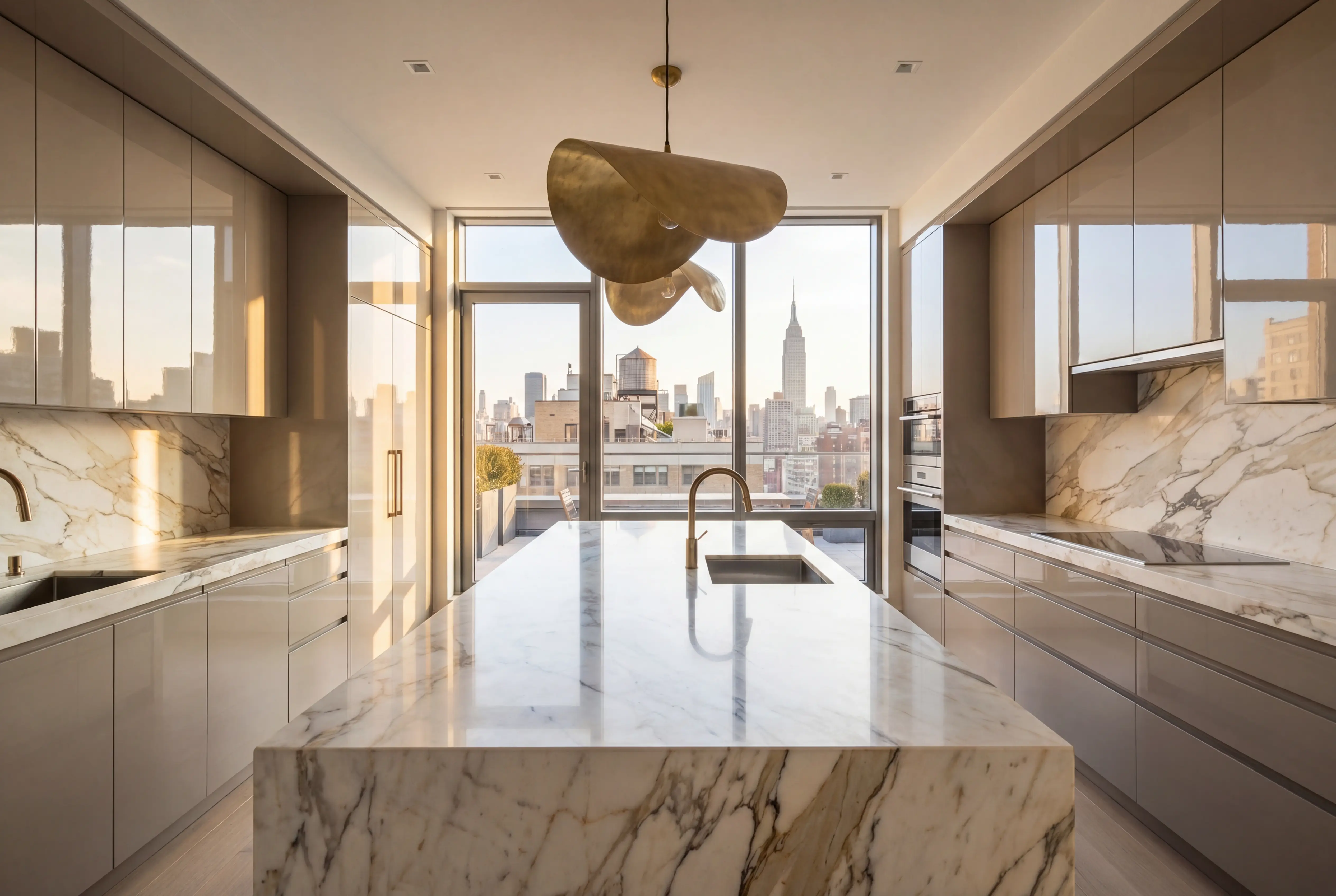
The kitchen is typically the highest-investment room in a Manhattan apartment renovation, and cabinetry accounts for a significant portion of that investment. It is also the single largest category of wood usage in a typical kitchen project - face frames, door panels, box components, interior components, and decorative elements all require substantial quantities of lumber and panel products.
FSC-certified lumber and plywood are available across the full range of species used in high-end Manhattan kitchen cabinetry, including white oak, walnut, hard maple, cherry, and painted MDF made from certified fiber. The certification does not impose any limitation on the aesthetic choices available - it is a sourcing standard, not a material constraint. An FSC-certified white oak cabinet door looks and performs identically to its uncertified counterpart; the difference is entirely in the documentation of where the wood came from and how the forest was managed.
Custom cabinet construction using FSC-certified materials requires working with a millwork fabricator who holds FSC Chain of Custody certification - a requirement that our Long Island City facility meets, ensuring that the chain of custody is unbroken through the fabrication stage. This is a point worth verifying with any millwork or cabinetry supplier you consider: Chain of Custody certification at the fabrication level is required for the finished product to carry the FSC label. A fabricator who purchases FSC-certified lumber but does not hold Chain of Custody certification cannot make a valid FSC claim on the finished cabinets. Reach out to KS Renovation Group to discuss FSC-certified cabinetry options for your Manhattan kitchen renovation.

Built-In Millwork, Paneling, and Architectural Storage
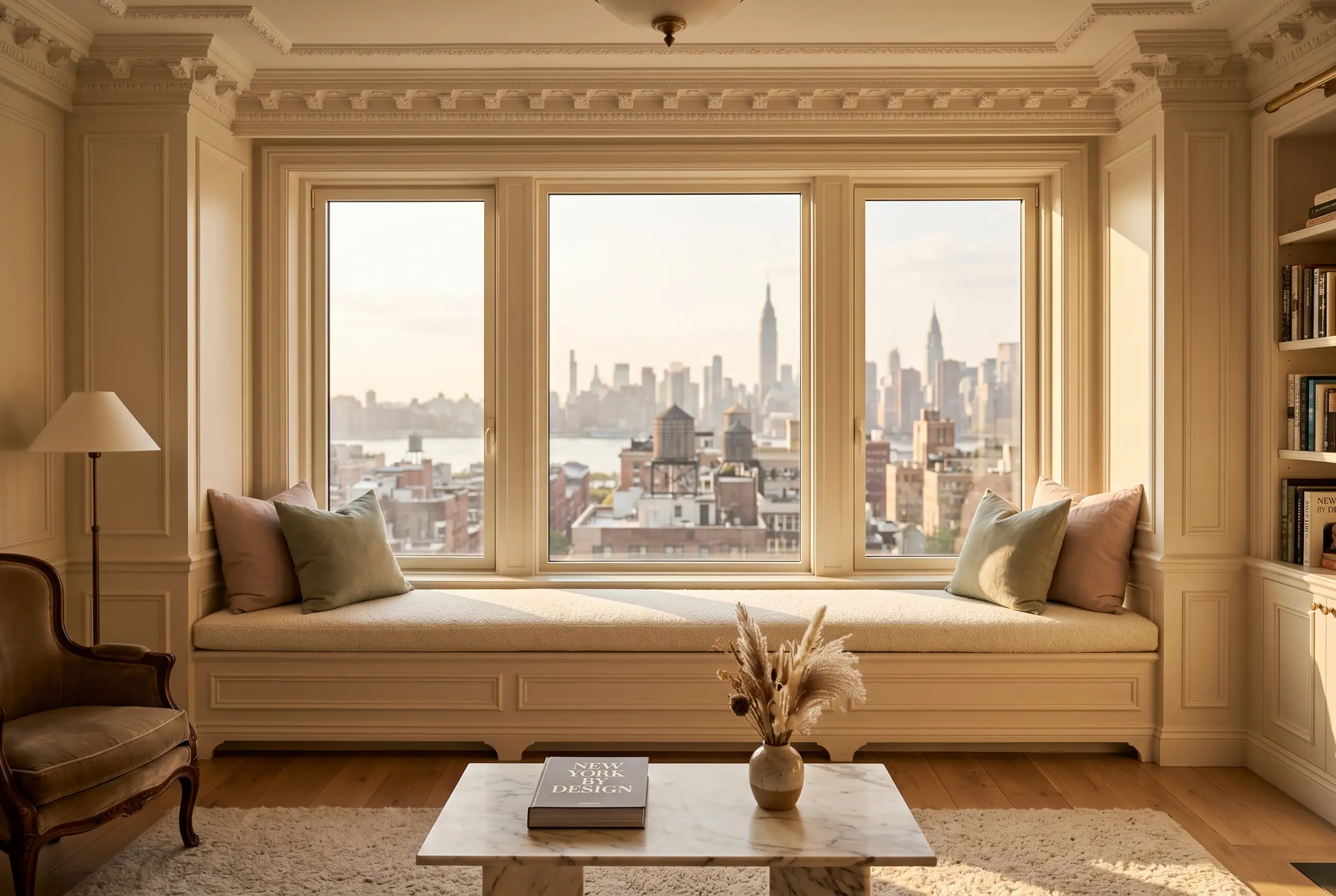
Custom millwork extends well beyond kitchen cabinetry in a Manhattan apartment renovation. Built-in bookshelves in the living room, custom closet systems in the bedroom, wall paneling in the entry foyer, integrated media walls in the study, and window seat storage throughout the apartment all represent significant wood usage that can be - and in our work, typically is - sourced from FSC-certified material.
Architectural wall paneling is a category where FSC-certified veneer plywood and solid lumber are readily available in the species and cuts most valued in Manhattan luxury interiors - quarter-sawn white oak, figured walnut, and book-matched panels among them. The visual richness of premium architectural paneling is entirely compatible with FSC certification; the finest veneer manufacturers in North America and Europe have pursued Chain of Custody certification in response to growing market demand from the high-end architectural and interior design community.
Built-in storage systems - the hallmark of KS Renovation Group’s work in Manhattan apartments - benefit from FSC-certified plywood and solid wood components in both their structural and visible elements. In our closet systems, the case material, shelving, hanging rods, and face components can all be specified in certified material, and the finish options - from painted lacquer to open-grain natural oil - are fully available in FSC-certified substrates.
Flooring Options: FSC-Certified Hardwood for Manhattan Apartments
Hardwood flooring is one of the most straightforward categories in which to specify FSC-certified material, because the FSC-certified solid hardwood flooring market is well-developed and offers competitive pricing relative to uncertified alternatives. White oak, red oak, hard maple, walnut, and hickory are all widely available in FSC-certified plank flooring in a range of widths, grades, and finished profiles.
In Manhattan apartment renovations, hardwood flooring decisions often involve both new installation and repair or extension of existing floors. When matching original pre-war hardwood - typically 2.25-inch or 3-inch strip oak in a clear or select grade - FSC-certified material in the appropriate species and dimension is available and is the specification we pursue wherever existing conditions permit. In full-floor replacements or in rooms where new flooring is being installed from scratch, the FSC-certified selection available in wide-plank white oak, engineered walnut, and other premium species meets the full range of Manhattan luxury interior aesthetic requirements.
Engineered hardwood flooring - a construction that bonds a solid wood face layer over a plywood core - is often the preferred specification for Manhattan apartments because it performs more stably across the humidity swings common in NYC apartment buildings, particularly in pre-war buildings with steam heat. FSC-certified engineered flooring is available and should be specified with both the face veneer and the plywood core components carrying valid chain of custody documentation.
Selecting FSC-Certified Species for Manhattan Interior Design
The practical question that follows naturally from understanding FSC certification is which species are available, which perform well in Manhattan interiors, and how they can be matched to the aesthetic direction of your renovation. The good news is that the FSC-certified species palette is broad enough to support virtually any design direction in the Manhattan luxury market.
White Oak, Walnut, Maple, and the Leading FSC Species for Manhattan Interiors
White oak has become the dominant species in Manhattan luxury interior design over the past several years, and its popularity has been accompanied by a well-developed FSC-certified supply chain. American white oak forests are among the most sustainably managed in the world - the Appalachian hardwood region is a net carbon sink, with growing stock increasing faster than harvest rates - and FSC-certified white oak lumber, plywood, and flooring are available from multiple suppliers at competitive pricing relative to the broader market.
Walnut - the dark, richly figured species that has seen a significant design revival in Manhattan interiors following the pandemic-era turn toward warmer, more organic materials - is available in FSC-certified form from both domestic and international suppliers. American black walnut, in particular, is sourced from well-managed forests in the central United States and is available with FSC certification across solid lumber, veneer plywood, and finished flooring formats. The design possibilities with FSC-certified walnut are identical to uncertified stock - the certification imposes no constraint on the grain character, figure, or color range available.
Hard maple, a species favored for painted cabinetry substrates and for contemporary kitchen designs where the light, uniform grain of maple complements minimalist aesthetics, is available in FSC-certified form from North American suppliers. Maple forests in the Northeast and Great Lakes regions are among the most actively managed in the country, and the FSC-certified supply in both solid and panel form is reliable and consistent.
Cherry, traditionally associated with formal and transitional interior styles that remain popular in certain Upper East Side and Upper West Side co-op renovations, is available in FSC-certified domestic form. The warm reddish tones of American cherry and its characteristic deepening with light exposure make it a distinctive choice, and FSC-certified cherry adds environmental credibility to a species whose old-world associations are already appreciated in classic Manhattan interiors.

Matching FSC Species to Your Apartment’s Style and Existing Materials
In pre-war Manhattan apartments, the most common existing wood material is the original strip hardwood flooring - typically red or white oak in a 2.25-inch width, often with a honey or amber tone from decades of finishing and refinishing. When a renovation involves extending or repairing these floors while adding new millwork, matching the species in FSC-certified form is both aesthetically important and straightforwardly achievable.
The more nuanced design challenge arises when a renovation involves multiple wood species across different applications - a white oak floor, walnut cabinetry, and a painted built-in that uses maple as its substrate, for example. In this scenario, each species sourcing decision is independent, and FSC-certified options are available across all three. The design challenge is the same as in any multi-species interior project: ensuring that the species interact harmoniously in terms of tone, grain scale, and finish approach. KS Renovation Group’s design team has extensive experience in Manhattan multi-species interior projects and can guide both the aesthetic and the sourcing decisions simultaneously.
For new apartment renovations without existing wood elements to match - full gut renovations, apartment combination projects, or spaces where all surfaces are being replaced - the FSC species selection can be approached entirely on design merit, with the environmental standard simply built into the specification from the start. This is the most straightforward scenario for sustainable sourcing, and increasingly it is the default approach in our project work.
Durability Considerations for Manhattan’s Demanding Urban Environment
Manhattan apartments are high-use environments, and the hardwood materials in kitchens, living areas, and entry spaces are subjected to significant daily wear. FSC certification is a sourcing standard, not a performance standard - the durability of an FSC-certified wood product is determined by the same factors that determine the durability of any wood product: species hardness, construction method, finish type, and installation quality.
White oak and hard maple are among the hardest domestic hardwood species on the Janka hardness scale and are excellent choices for high-traffic areas in Manhattan apartments. Walnut is somewhat softer and shows wear more readily in very high-traffic areas like entry foyers, though its natural oils give it excellent resistance to warping and checking in variable humidity environments. Cherry sits at a similar hardness range to walnut and is better suited to moderate-traffic living spaces than to kitchens or entries.
For kitchen cabinetry and built-in millwork, the finish type and construction method matter more than species hardness. A properly constructed cabinet in FSC-certified maple with a catalyzed lacquer finish will outperform a poorly built cabinet in uncertified hardwood every time. Our Long Island City millwork facility produces cabinetry and built-ins to the construction standards of the highest-end market segment, applying the same rigorous joinery and finishing methods regardless of whether the substrate is FSC-certified or conventional material. The certification is about sourcing; the craftsmanship is about us.
The Value of Sustainable Renovation in Manhattan’s Luxury Market
Beyond the environmental arguments - which are significant and real - FSC-certified renovation materials offer Manhattan homeowners practical benefits that have direct bearing on the quality of their living environment, the performance of their home, and the long-term value of their investment.
Environmental and Indoor Air Quality Benefits in Your Manhattan Apartment
The environmental case for FSC-certified wood is straightforward: responsibly managed forests sequester carbon, protect biodiversity, maintain watershed health, and support sustainable livelihoods for the communities that depend on them. When Manhattan homeowners specify FSC-certified wood in their renovations, they are choosing materials whose production supports these outcomes rather than depleting them.
Less commonly discussed but equally important for apartment living is the indoor air quality dimension of sustainable material sourcing. FSC certification addresses forest management, but the most comprehensive sustainable renovation approach also considers the processing and finishing of wood products. Many certified millwork and flooring products in the FSC category also meet low-VOC (volatile organic compound) standards for adhesives, finishes, and composite materials - a meaningful benefit in the relatively air-tight environment of a modern Manhattan apartment where indoor air quality is directly affected by the off-gassing of construction materials.
Formaldehyde emissions from composite wood products - plywood, MDF, and particleboard used as cabinet and millwork substrates - have been a significant indoor air quality concern in residential construction. CARB Phase 2 compliant composite panels (the California Air Resources Board standard that is now effectively national) are the baseline specification for responsible cabinetry and millwork, and these panels are available in FSC-certified form. Specifying FSC-certified, CARB-compliant composite panels for your Manhattan cabinetry project addresses both the sourcing dimension and the indoor air quality dimension simultaneously.
Resale Value and the Growing Sustainability Premium in Manhattan Real Estate
Manhattan’s luxury real estate market has shown increasingly clear evidence that sustainability features command a price premium at resale. Buildings that have pursued LEED certification or energy efficiency upgrades consistently achieve stronger per-square-foot valuations than comparable non-certified buildings, and this pattern has extended from building-level sustainability to apartment-level renovation features.
The US Green Building Council, which administers the LEED certification system, has documented growing buyer demand for sustainability features in residential real estate across all market segments, with the effect most pronounced in the high-end market where buyers have both the resources to prioritize sustainability and the information to evaluate it. Manhattan’s buyer pool is particularly sophisticated in this regard - many of the buyers active in the luxury co-op and condo market have professional or personal connections to sustainability, architecture, or design that make material sourcing credentials meaningful to them.
From a practical renovation planning perspective, this means that FSC-certified wood in a Manhattan apartment renovation is not only the environmentally responsible choice - it is an investment in the asset value of the apartment. The ability to document responsible material sourcing as part of the renovation record adds a verifiable sustainability credential to the property that can be communicated clearly to future buyers.

FSC Certification and the Broader Green Building Picture for Manhattan Buildings
FSC-certified wood is one component of a broader sustainable building materials framework that is increasingly relevant to Manhattan renovation projects. The LEED for Homes rating system includes credits for FSC-certified wood, as does WELL Building Standard, and many Manhattan buildings pursuing these certifications require or strongly prefer that renovation work within individual apartments use certified materials.
The NYC Sustainability Initiative and the City’s broader commitment to reducing embodied carbon in construction - the carbon associated with the production of building materials rather than the energy used to operate a building - are placing increasing scrutiny on the material content of renovation projects. Embodied carbon accounting gives particular weight to wood products from responsibly managed forests, because sustainably harvested wood stores carbon sequestered from the atmosphere and represents a significantly lower embodied carbon footprint than steel, concrete, or synthetic materials performing equivalent functions.
For Manhattan homeowners whose buildings are pursuing sustainability certifications, or who want their renovation to align with the City’s environmental goals, specifying FSC-certified wood is the most straightforward and well-documented contribution available in the material selection process. Contact KS Renovation Group to discuss how FSC-certified materials can be integrated into your renovation specification and documented for certification purposes.
Conclusion
The luxury renovation market in Manhattan is in the middle of a fundamental shift in what it means to build beautifully. Environmental responsibility has moved from the margins of design conversation to its center, and the homeowners who are making significant investments in their apartments in 2026 are increasingly clear that they want materials they can stand behind - materials whose origins reflect the same values of quality, integrity, and long-term thinking that characterize their other major decisions.
FSC certification is not a compromise. It is not a second-tier option selected when the preferred material is unavailable. It is the standard to which the finest millwork, cabinetry, and flooring manufacturers in the world are working - because it is the standard that the most demanding clients in the most demanding markets are now expecting. In Manhattan’s luxury renovation sector, the question is no longer whether FSC-certified wood is available for the applications you’re planning. It is simply a matter of working with a team that has the sourcing relationships, the chain of custody certification, and the manufacturing expertise to deliver it.
KS Renovation Group is committed to FSC-certified wood sourcing as a standard of practice across our custom millwork, kitchen cabinetry, and built-in projects. Our Long Island City facility holds FSC Chain of Custody certification, and we work with certified lumber and panel suppliers whose documentation provides genuine assurance - not marketing language - that the materials in your Manhattan apartment were produced responsibly. If you are planning a renovation in 2026 and want to build something that you can be proud of in every dimension, we would be glad to discuss what that looks like in your specific project. Contact KS Renovation Group today to schedule a consultation with our Manhattan renovation specialists.
Frequently Asked Questions
1. What does FSC certification mean for wood used in a Manhattan kitchen renovation?
FSC certification means that the wood used in your kitchen cabinets, custom millwork, or other wooden elements has been sourced from forests managed according to the Forest Stewardship Council’s standards for responsible forestry, and that its journey from the forest through every step of processing and fabrication has been documented and audited by independent third parties. The FSC label is not self-certified - it requires ongoing third-party audits of both the forest operation and every company in the supply chain, including the millwork fabricator. For Manhattan homeowners, it means you can verify that your renovation materials meet a meaningful environmental standard rather than relying on unverifiable “eco-friendly” claims.
2. Does specifying FSC-certified wood limit my design options for a Manhattan apartment renovation?
No. FSC certification is a sourcing standard, not an aesthetic constraint. The most popular species for Manhattan luxury interiors - white oak, walnut, hard maple, and cherry - are all available in FSC-certified form across solid lumber, veneer plywood, flooring, and panel products. The full range of finishes, profiles, and cuts available in conventional lumber are equally available in FSC-certified material. Working with a millwork fabricator who holds FSC Chain of Custody certification, as KS Renovation Group does, ensures that the certification is maintained through the fabrication stage without limiting any aesthetic or design decision.
3. Is FSC-certified wood more expensive than conventional lumber for a Manhattan renovation?
The pricing difference between FSC-certified and uncertified lumber varies by species and market conditions, but for the major domestic hardwood species used in Manhattan luxury interiors, the premium is modest - typically in the range of five to fifteen percent over conventional material, depending on the species and product format. In the context of a full kitchen renovation or significant custom millwork project, this represents a small fraction of the overall project investment. The more relevant cost consideration is the fabricator’s Chain of Custody certification status: a fabricator without this certification cannot pass FSC claims through to the finished product regardless of what lumber they purchase, which is why working with a certified fabricator like KS Renovation Group is the essential foundation of a credible FSC specification.
4. Can FSC-certified materials contribute to LEED certification for my Manhattan apartment building?
Yes. The LEED for Homes rating system and LEED for Building Operations and Maintenance both include credits for FSC-certified wood products, specifically recognizing that responsible forest management reduces embodied carbon and supports sustainable land use. If your Manhattan building is pursuing LEED certification or your co-op board has established sustainability goals for renovation projects, specifying FSC-certified wood for your millwork and flooring is a well-documented contribution that can be verified and credited. KS Renovation Group can provide the chain of custody documentation needed for LEED credit submissions as part of our project close-out process.
5. How do I verify that the FSC-certified wood in my renovation is genuinely certified and not a greenwashing claim?
The most reliable verification method is to check that both the lumber or panel supplier and the millwork fabricator hold current FSC Chain of Custody certification, which can be confirmed through the FSC certificate database at info.fsc.org. Certified companies maintain publicly searchable certificate numbers, and valid certificates include the certificate holder’s name, the scope of their certification, and the expiration date. When KS Renovation Group specifies FSC-certified material for a project, we can provide our Chain of Custody certificate number and the certificate numbers for the lumber and panel suppliers in our supply chain, giving homeowners complete transparency about the certification status of the materials going into their apartments.

You may also be interested


KS Renovation Blog
Get Inspired
Meaningful information about home remodeling for the true NYC homeowners.

OUr Clients Say

William Plotch
amy schorr
gberaka
NYC kitchen remodeling Projects and more


