
Panel-Ready Appliances: Seamless Manhattan Kitchen Design Guide
Spring is here - and if you're a Manhattan homeowner, that familiar urge to declutter, simplify, and reclaim your space is already setting in. But what if the most transformative thing you could do this season isn't a deep clean - it's a complete rethink of how your kitchen looks and lives?
In New York City's most design-forward apartments and townhouses, a quiet revolution is underway. Refrigerators are disappearing behind custom cabinetry. Dishwashers vanish into millwork panels. Even range hoods dissolve into seamless facades. The result? A kitchen that feels less like a utilitarian workspace and more like a beautifully curated room - calm, uncluttered, and unmistakably European in sensibility.
This is the world of panel-ready and integrated appliance design, and it's redefining what's possible in minimalist Manhattan kitchens. If zero visual noise is your goal, you've just found your blueprint. And if you're ready to bring it to life, KS Renovation Group has the custom millwork expertise to make it happen seamlessly.
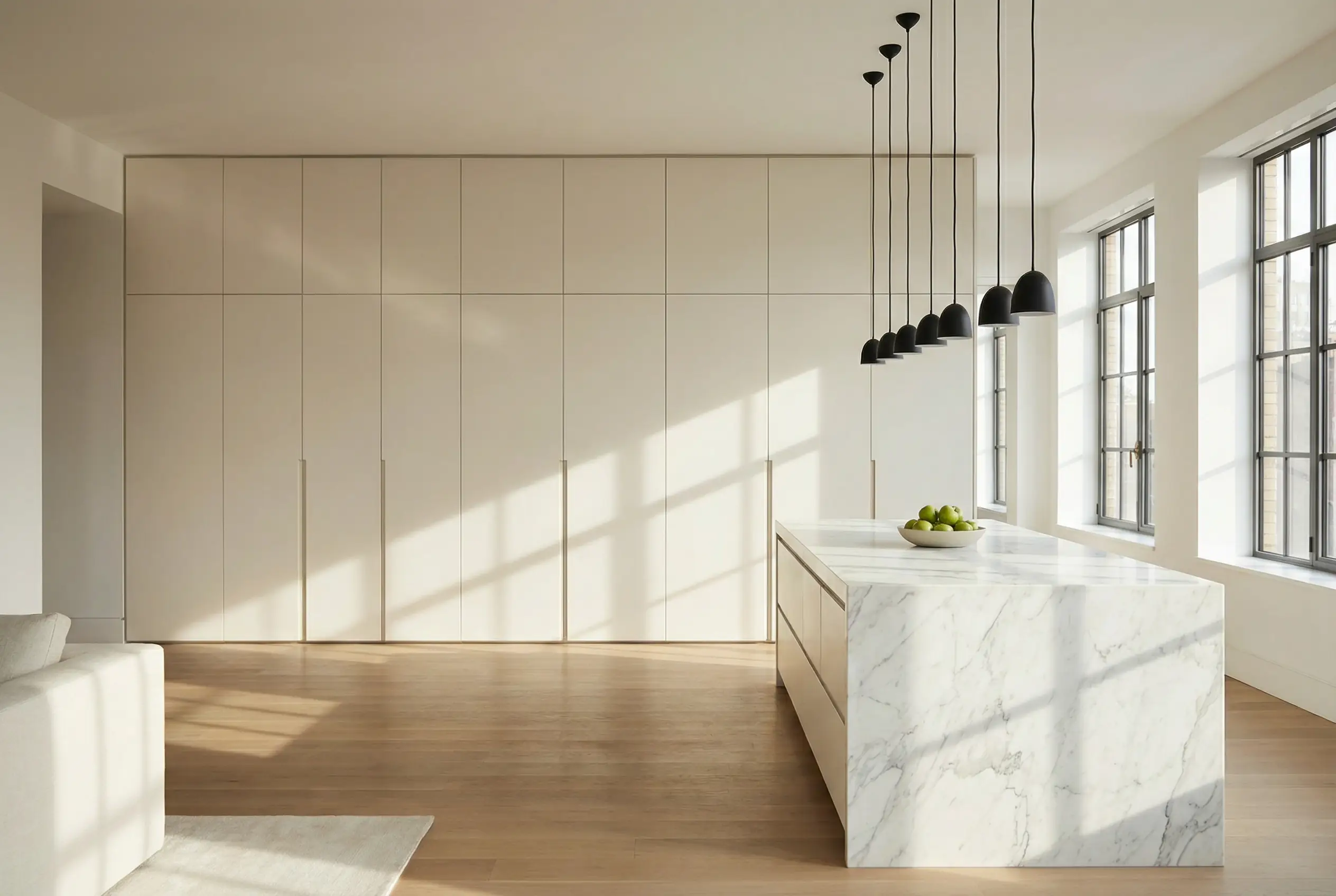
What Are Panel-Ready Appliances - And Why Is Manhattan Obsessed With Them?
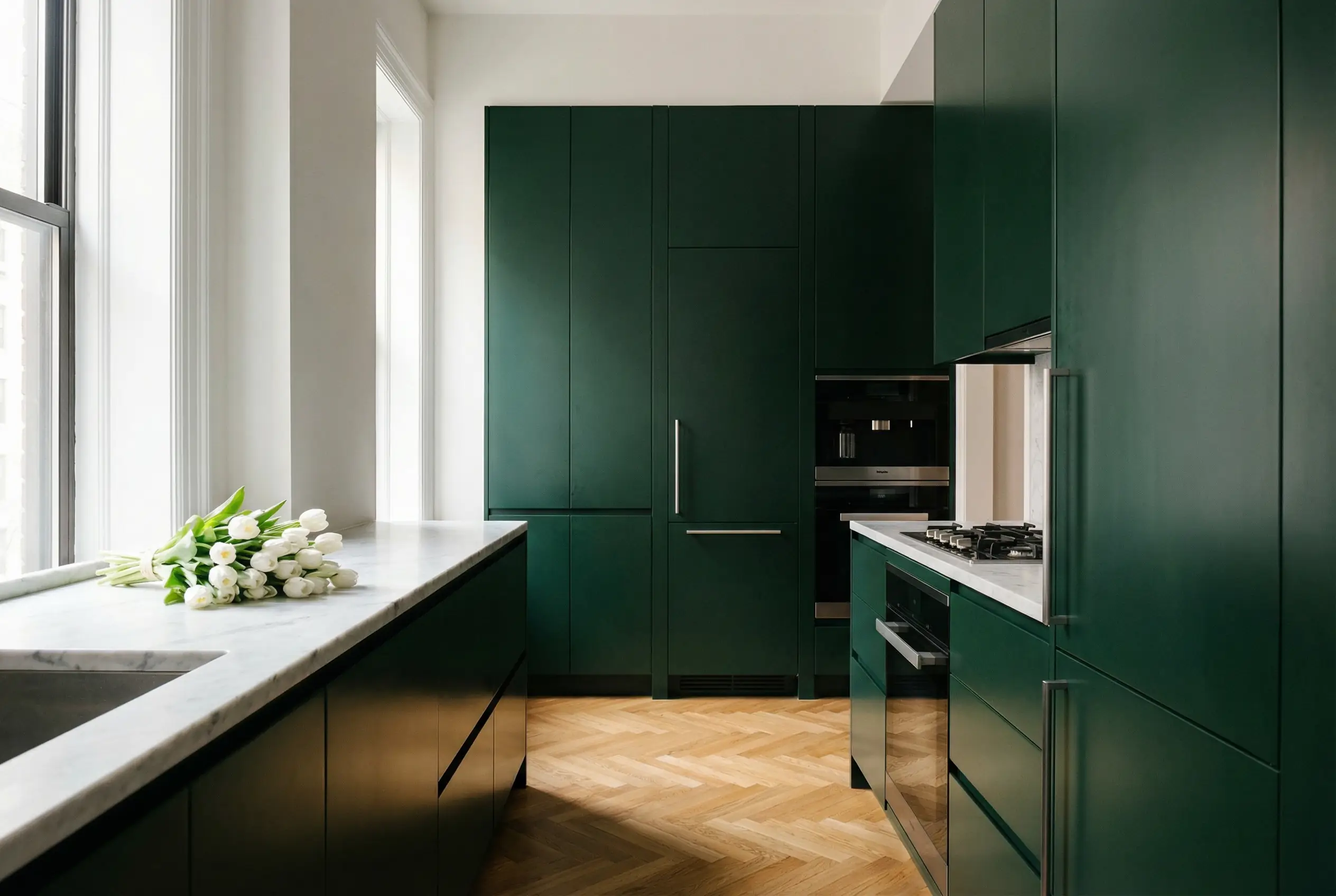
Panel-ready appliances are purpose-built to accept custom decorative panels on their exterior faces, making them visually indistinguishable from the surrounding cabinetry. Unlike standard stainless steel appliances that command visual attention the moment you walk into a room, panel-ready units simply disappear into the design.
In a city where square footage is precious and every design decision carries weight, this approach is more than aesthetic preference - it's spatial intelligence.
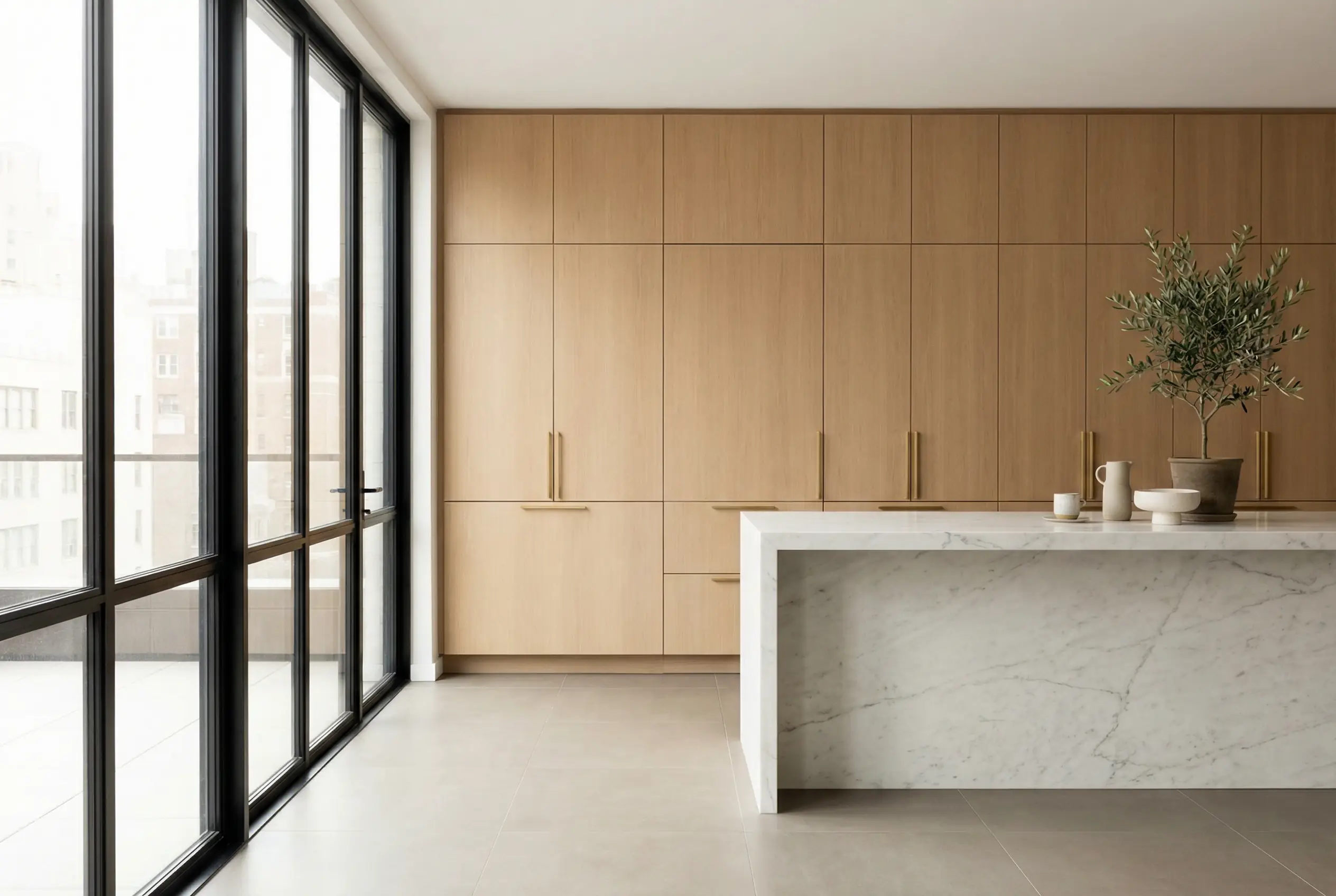
The European Aesthetic That's Taking Over NYC
The integrated appliance concept has long been standard in high-end European kitchens, particularly in German, Italian, and Scandinavian design traditions. Where American kitchens historically celebrated appliances as status symbols - gleaming stainless steel, bold commercial ranges - European design philosophy moves in the opposite direction: everything concealed, everything considered, nothing superfluous.
Manhattan's design-conscious homeowners have fully embraced this sensibility. In neighborhoods like Tribeca, the West Village, and the Upper East Side, integrated kitchen appliances NYC style are no longer a luxury novelty - they're the expected standard in premium renovations.
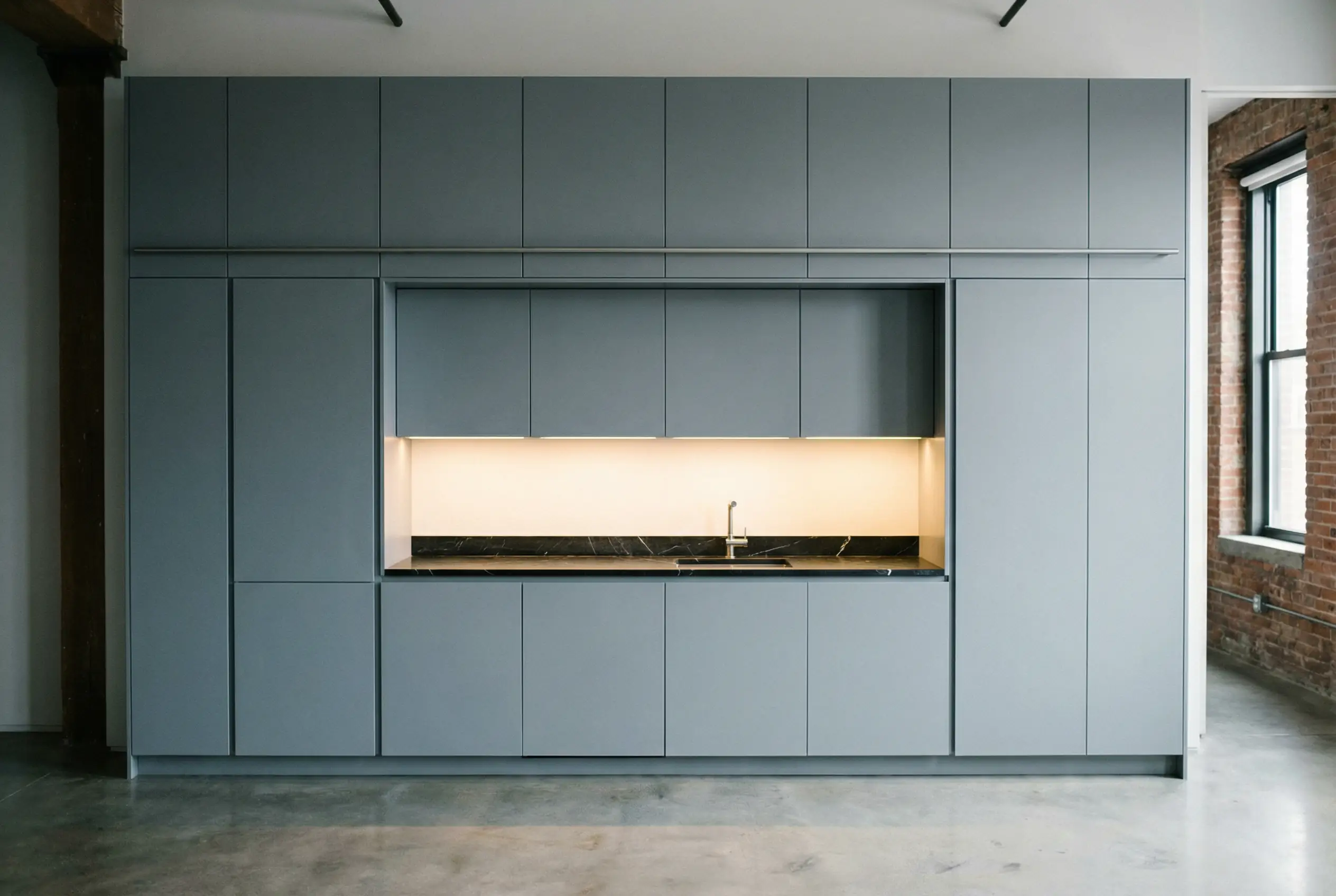
The Psychology of Visual Clutter - And Why It Matters in Small Spaces
Research consistently shows that visual clutter elevates stress hormones and impairs cognitive focus. In a Manhattan kitchen where your cooking, working, and entertaining spaces often overlap, every visual element that demands attention adds to your mental load.
Panel-ready appliances eliminate the most visually dominant objects in the average kitchen in a single design move. The refrigerator - typically the largest, most visually imposing element - becomes a wall. The dishwasher becomes a cabinet door. Suddenly, the eye has nowhere to snag, and the room breathes.
The Anatomy of a Seamless Kitchen: What Integration Really Involves
True seamless kitchen design is not simply about slapping a panel on a refrigerator door. It requires meticulous coordination between your appliance specifications, your cabinetry system, and the architectural realities of your space. Done poorly, integrated kitchens look forced and amateur. Done with precision, they are genuinely breathtaking.
Custom Millwork Paneling: The Heart of the System
The panels themselves are the critical element - and this is where craftsmanship makes or breaks the result. Custom millwork panels must match your cabinetry in species, grain direction, finish, and hardware profile with absolute precision. Any variation in material, tone, or texture will betray the seam immediately.
This is why integrated kitchen appliances NYC projects demand a renovation partner with serious millwork capabilities - not simply a contractor who installs cabinets from a manufacturer catalog. At KS Renovation Group, custom millwork is a core competency, allowing panels to be fabricated to exact specification so the transition between appliance and cabinet is genuinely invisible.
Ventilation, Clearance, and the Technical Realities
One aspect homeowners often underestimate is the technical complexity behind the panels. Refrigerators require specific air circulation clearances. Integrated dishwashers need precise door alignment to prevent sagging over time. Built-in ovens require fire-rated surrounds and proper ventilation channels.
A beautiful panel means nothing if the appliance behind it overheats, malfunctions, or warps the millwork within a year. Every integrated installation must be engineered as carefully as it is designed - with ventilation pathways, proper clearances, and long-term structural integrity built into the plan from day one.
Handles, Hardware, and the Art of Minimalist Detail
In a truly seamless kitchen, even hardware choices carry enormous weight. Integrated appliances typically use one of two handle philosophies: recessed grip channels machined into the panel edge for a completely handle-free look, or through-matched hardware where appliance pulls are identical to cabinet pulls, maintaining visual rhythm across the entire wall.
The handle decision affects the entire kitchen's character. Push-to-open mechanisms eliminate hardware entirely, creating the purest, most architectural expression of the concept. Your design vision determines the direction - and the right renovation partner helps you think through every implication.
Panel-Ready Appliances Manhattan: Room-by-Room Integration Possibilities
While the kitchen is the primary stage for integrated appliance design, the philosophy extends throughout the home - particularly relevant in Manhattan apartments where every room must work harder.
The Hidden Refrigerator: Your Biggest Visual Win
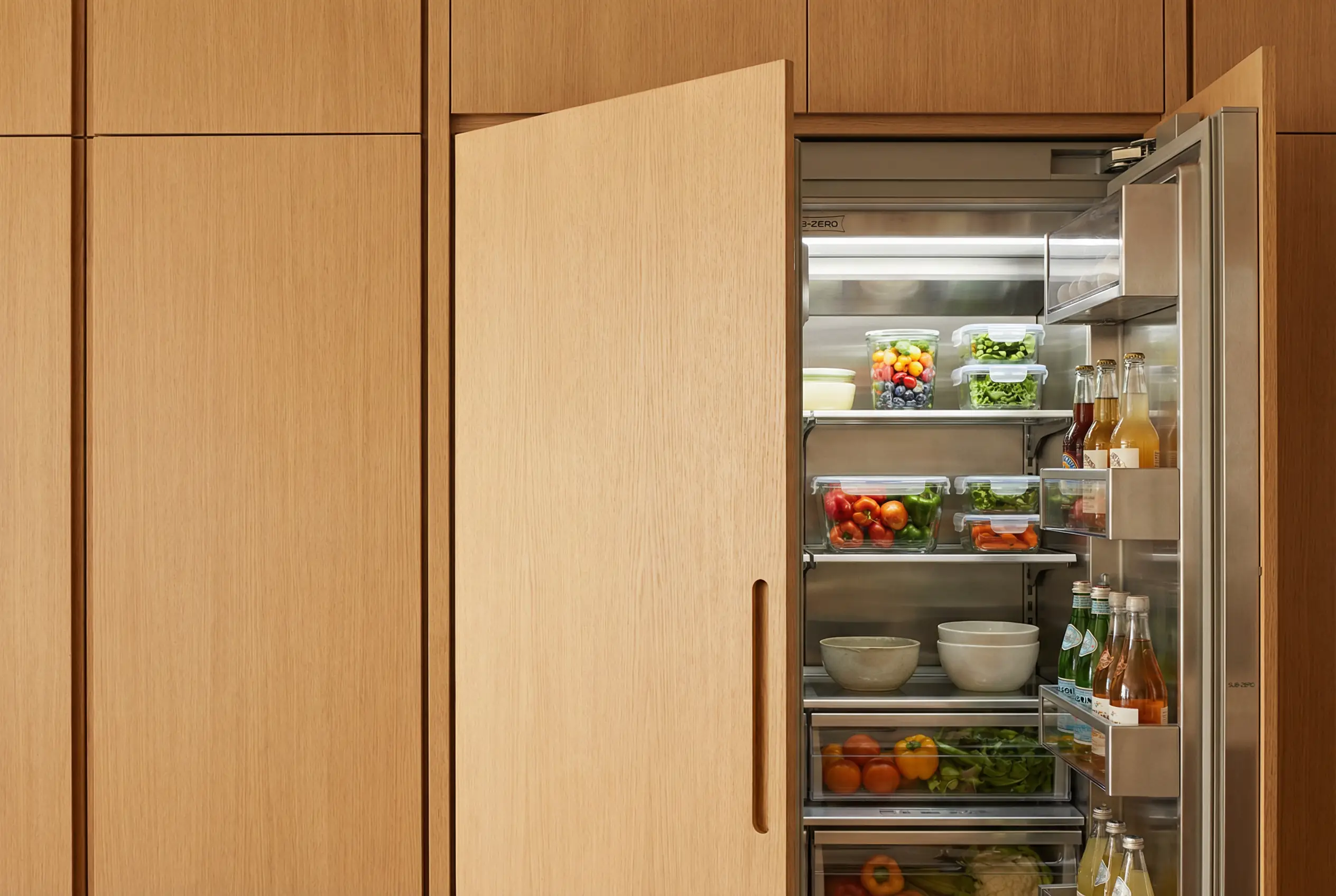
The hidden refrigerator is the crown jewel of integrated kitchen design and the single most impactful change you can make to a kitchen's visual character. A full-height refrigerator behind matched cabinetry panels can reduce the perceived visual complexity of an entire kitchen wall by 40-60% - transforming a busy, appliance-dominated space into something that reads as pure architecture.
Counter-depth and fully integrated column refrigerators from brands like Sub-Zero, Miele, Liebherr, and Gaggenau are specifically engineered for this purpose, with flush-mount installation and panel-ready door systems. The result is a kitchen where you genuinely cannot identify the refrigerator until you open the door - which, if you love the effect, is enormously satisfying every single time.
Dishwashers, Wine Columns, and Warming Drawers
Beyond the refrigerator, the integrated appliance ecosystem extends to virtually every functional element in the kitchen. Panel-ready dishwashers eliminate the stainless steel rectangle that typically interrupts lower cabinetry runs. Integrated wine columns slot into cabinetry systems for seamless entertaining setups. Warming drawers, microwave drawers, and speed ovens all have panel-ready counterparts designed to vanish on command.
The cumulative effect of full integration - where every appliance disappears - is genuinely transformative. The kitchen stops reading as a collection of appliances surrounded by cabinetry and becomes a single, unified architectural statement.
Beyond the Kitchen: Integrated Laundry and Wet Bar Applications
In Manhattan apartments where the laundry is tucked into a hallway closet or the wet bar doubles as a home office credenza, integrated appliance paneling creates visual continuity that makes the whole apartment feel more considered and composed. Washer-dryer units behind matched millwork panels, under-counter refrigerators in home bars, and built-in wine refrigerators in dining rooms are all natural extensions of the same design philosophy.
KS Renovation Group approaches whole-home renovation with this kind of continuity in mind - ensuring that design language developed in the kitchen carries meaningfully through every space.
Choosing the Right Partner for Integrated Kitchen Appliances NYC
This is where many homeowners make a costly mistake. Integrated appliance installation looks deceptively simple in finished photographs. In reality, it demands a level of coordination, precision, and millwork expertise that separates excellent renovation firms from average ones.
What to Look for in a Manhattan Renovation Specialist
Your renovation partner needs to demonstrate proficiency in three distinct areas simultaneously: appliance specification knowledge (understanding which brands and models are genuinely panel-ready versus merely "panel-compatible"), custom millwork fabrication (the ability to produce panels that truly match your cabinetry system), and project coordination (managing the precise sequencing of appliance delivery, cabinet installation, and panel fitting so nothing is forced or compromised).
Ask to see completed integrated kitchen projects. Look at the seams, the hardware alignment, the gap consistency between panels. These details reveal everything about a firm's actual capabilities.
Why Custom Millwork Makes All the Difference
Pre-manufactured panel kits offered by appliance brands are designed for generic compatibility - they rarely achieve the precision fit and material match that custom millwork provides. When your goal is a kitchen that genuinely looks like a single continuous surface, custom-fabricated panels are not a luxury upgrade. They are the minimum requirement.
KS Renovation Group specializes in exactly this kind of high-precision custom millwork for Manhattan kitchens and whole-home renovations. If seamless integration is your vision, explore their full range of renovation services here and take the first step toward a kitchen that truly disappears into beauty.
Conclusion: The Kitchen That Disappears Is the One You'll Never Stop Loving
Spring's decluttering energy is powerful - but the deepest form of decluttering isn't organizational. It's architectural. When the appliances vanish behind custom millwork panels, when the kitchen reads as one calm, unified surface, something genuinely shifts in how the space feels to live in every day.
Panel-ready appliances in a Manhattan kitchen aren't about hiding things. They're about revealing what's truly important: the quality of the materials, the intelligence of the layout, the craft of the joinery. When everything superfluous is removed, what remains is remarkable.
If you've been sitting with the vision of a kitchen that feels like this - minimal, European, impossibly clean - this is the season to move from vision to reality.
Connect with KS Renovation Group today to discuss your integrated kitchen project. Our team brings the custom millwork expertise, appliance coordination knowledge, and Manhattan renovation experience your vision deserves. Don't just declutter your countertops this spring - transform the entire room.
Frequently Asked Questions
Q1: What's the difference between "panel-ready" and "integrated" appliances? Panel-ready appliances are designed to accept a decorative panel on their exterior, making them match surrounding cabinetry. Fully integrated appliances take this further - they are designed to be completely hidden within the cabinetry system, often with no visible controls on the front face. Both approaches achieve the seamless look, with full integration representing the more complete expression of the concept.
Q2: Which appliance brands work best for integrated kitchen design in Manhattan apartments? Sub-Zero, Miele, Gaggenau, Liebherr, and Fisher & Paykel are consistently regarded as the leading panel-ready appliance brands for high-end integrated kitchens. Each offers dedicated panel-ready product lines engineered specifically for seamless integration, with precise tolerances and flush-mount installation systems. Your renovation partner can help match brand selection to your cabinetry system and spatial requirements.
Q3: Can panel-ready appliances be added to an existing kitchen, or does the whole kitchen need to be renovated? Retrofitting panel-ready appliances into an existing kitchen is possible but requires careful assessment. The existing cabinetry must be compatible with the appliance dimensions, and new custom panels must be fabricated to match the existing cabinet finish - which can be challenging if the original cabinetry finish is discontinued or difficult to replicate. In many cases, a partial or full kitchen renovation produces a better result. KS Renovation Group can evaluate your existing space and recommend the right scope of work.
Q4: How do integrated refrigerators handle ventilation in a Manhattan apartment? Integrated and panel-ready refrigerators are specifically engineered to function within cabinetry enclosures, with ventilation systems designed to work through grilles at the top, bottom, or rear of the unit rather than the sides. However, installation must respect the manufacturer's required clearance specifications precisely - inadequate ventilation will affect performance and longevity. This is a key reason why professional installation by a renovation team experienced with integrated appliances is essential.
Q5: Does seamless kitchen design work in smaller Manhattan kitchens, or is it only for large spaces? Integrated appliance design actually performs better in smaller kitchens than in large ones. By eliminating the visual mass of stainless steel appliances, panel-ready integration makes compact kitchens feel significantly larger and more open. In a galley kitchen or a combined kitchen-living space in a Manhattan apartment, this visual simplification can be genuinely transformative - which is precisely why the approach has become so popular across all Manhattan apartment sizes, from studios to full-floor penthouses.

You may also be interested




KS Renovation Blog
Get Inspired
Meaningful information about home remodeling for the true NYC homeowners.

OUr Clients Say

William Plotch
amy schorr
gberaka
NYC kitchen remodeling Projects and more


